
Knowledge hub
Best Fan for a Windowless Bathroom (2026): Complete Buying Guide
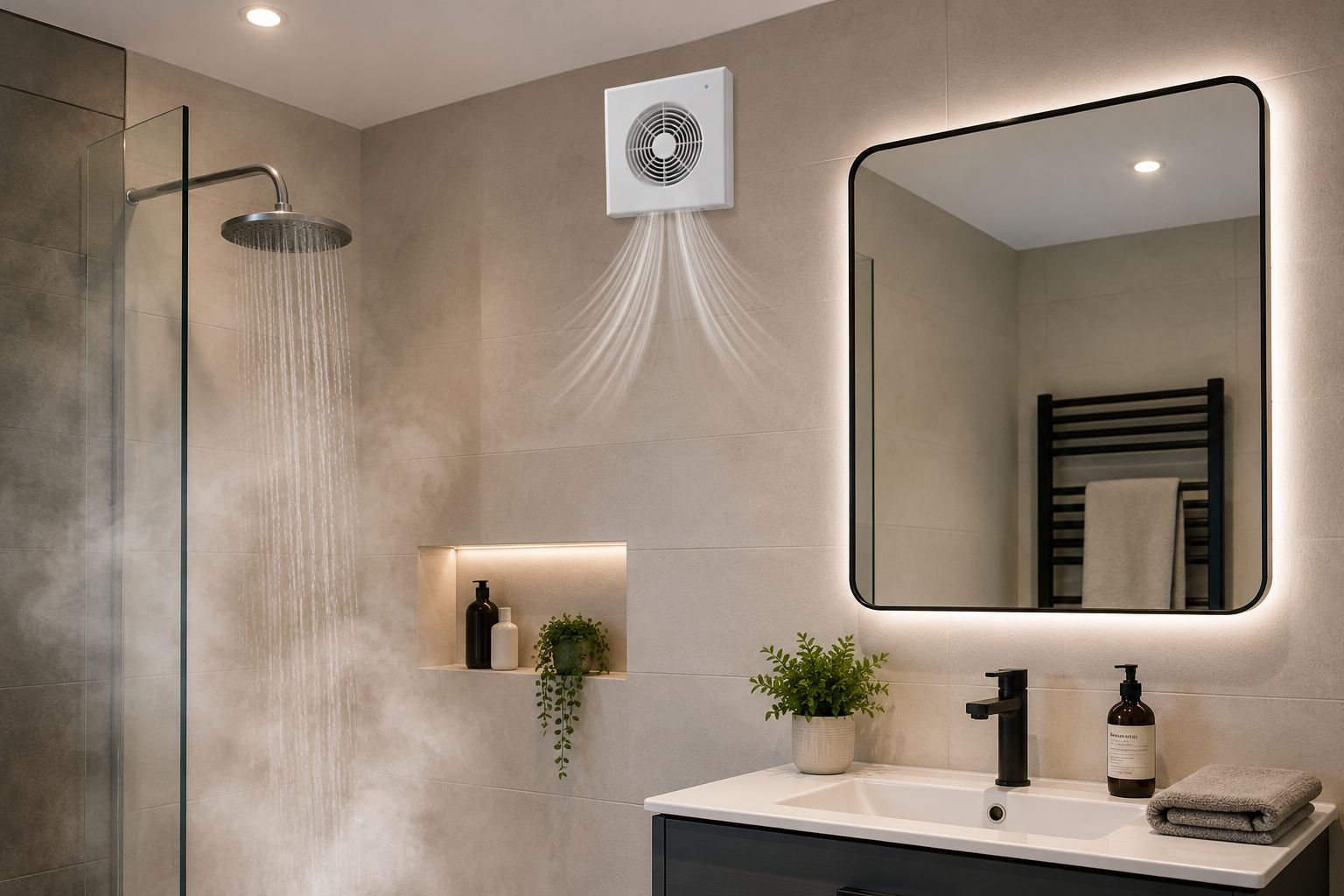
Choosing the best fan for a windowless bathroom is essential for preventing condensation, mould and poor indoor air quality. After a shower, moisture remains on tiles, mirrors, ceilings and cold pipework until mechanical extraction removes it. The best fan for a windowless bathroom is therefore selected by matching airflow, duct resistance, controls and noise level to the room and installation rather than simply choosing the highest advertised airflow.
Effective ventilation is also recommended by the World Health Organization guidance on dampness and mould in buildings as an important measure for reducing moisture-related indoor health risks.
A correctly specified extractor fan reduces condensation, protects finishes and lowers the conditions that encourage mould. It should also be practical enough that occupants will run it consistently. For most homes, that means a quiet fan with an effective overrun timer or humidity sensor, installed with a suitable duct route to the outside.
Looking for the right Bathroom Extractor Fans for a windowless bathroom? This guide explains how to choose the correct airflow, controls and installation for reliable moisture removal and long-term protection against condensation.
How to Choose the Best Fan for a Windowless Bathroom
The best option is usually a continuously rated axial or mixed-flow Bathroom Extractor Fan connected to an external wall or roof outlet. It must move sufficient air against the resistance of the ducting, rather than simply perform well in free-air laboratory conditions.
Across Europe, building regulations typically specify minimum extract ventilation rates for bathrooms. These figures should be treated as a baseline rather than an automatic buying recommendation, as the correct fan also depends on room size, duct resistance and how the bathroom is used.
A compact cloakroom with a short, straight 100 mm duct may work well with a quiet 90–100 m³/h axial fan. A family bathroom with frequent showers, a long duct run or several bends may need a higher-pressure mixed-flow fan, often in the region of 120–200 m³/h depending on the system design.
The fan should always extract to the exterior. Discharging moist bathroom air into a loft, ceiling void or garage simply transfers the condensation problem to a concealed area where timber, insulation and electrical components can be damaged. A fan is only one part of the ventilation system: ducting, external termination and a source of replacement air all influence real-world performance.
Airflow is not the only performance figure
Airflow is normally stated in m³/h or litres per second. Compare figures carefully, because manufacturers may list a maximum free-air flow rate alongside a separate performance curve. Once air travels through Flexible Air Ducts, bends, grilles and a backdraught shutter, static pressure rises and delivered airflow falls.
Axial fans are compact and economical, but they are best suited to short, straight duct runs. If the duct route is longer than roughly 1.5 to 2 metres, includes multiple 90-degree bends or exits through a roof terminal, a fan with better pressure capability is often the safer choice. Mixed-flow Inline Duct Fans and centrifugal models maintain airflow more effectively under resistance, although they can require more installation space and planning.
Duct diameter matters too. A 100 mm connection is common in smaller bathrooms, while 125 mm and 150 mm systems can move more air at lower air velocity. Reducing a larger fan outlet to a smaller duct creates unnecessary resistance, additional noise and poorer extraction performance. Whenever possible, match the fan spigot, duct diameter and external termination to achieve the best airflow.
Choose the control method around how the bathroom is used
A basic fan switched with the bathroom light is simple, but it often stops just as steam is building. In a windowless bathroom, the control method has a direct impact on how effectively moisture is removed.
A Bathroom Fan with Timer keeps the fan operating after the light is switched off. A typical adjustable range is two to 30 minutes. This is suitable where showering patterns are predictable and users may otherwise turn the fan off too early. Set the run-on period based on how quickly mirrors clear and surfaces dry, rather than selecting the shortest setting simply to reduce electricity use.
A Humidity Sensor Bathroom Fan starts automatically when relative humidity rises above a selected threshold, commonly adjustable between about 60% and 90% RH. It can respond to a shower even if the light is not used, making it particularly useful in en-suites and households where ventilation habits vary. The trade-off is that poorly positioned sensors may react to humid air from elsewhere in the home, while a threshold set too low can result in unnecessary operation.
A fan with both humidistat and timer control offers greater flexibility. Some advanced models also include trickle ventilation, delayed start and automatic boost modes. Continuous low-speed extraction can be particularly effective in frequently used bathrooms, provided the fan is designed for continuous operation and the background noise remains comfortable.
Noise: look beyond the headline decibel figure
Bathroom fan noise is stated in dB(A), but the figure is meaningful only when you know the measurement conditions and operating speed. A fan rated at 25 dB(A) on a low setting may be noticeably louder when operating at full boost, while sound can also be amplified by rigid ducting, loose ceiling boards or restrictive duct components.
For bathrooms close to bedrooms, prioritise a low-speed sound level of around 20–30 dB(A), while ensuring sufficient boost capacity for showering. An inline fan installed in a loft or ceiling void can often be quieter inside the bathroom because the motor is positioned away from the ceiling grille. However, it still requires accessible installation, safe electrical connection and properly supported ducting to minimise vibration.
Use smooth rigid or semi-rigid ducting wherever possible. Flexible Air Ducts are ideal for short final connections, but long unsupported flexible ducts can sag, create turbulence and collect condensation. Keep duct runs as short and straight as possible, avoid sharp bends, support the ducting correctly and use insulated duct where it passes through unheated spaces. These installation details often have a greater impact on overall noise and airflow than changing between two similarly rated fans.
Installation factors that decide whether a fan works
Every extractor fan requires replacement air. If a bathroom door seals too tightly, the fan cannot extract efficiently. A suitable undercut beneath the door, often around 10 mm depending on the ventilation design, allows fresh air to enter from the adjoining space. This should always be considered alongside fire, acoustic and accessibility requirements.
Position the extract grille where humid air naturally accumulates, typically close to the shower or bath while remaining outside the relevant electrical installation zones. Bathroom electrical work must comply with local regulations, and the fan’s IP rating should always be appropriate for its installation location. In many situations an IPX4-rated fan or a low-voltage model is suitable, although the correct choice depends on the specific installation.
A backdraught shutter helps prevent cold air entering the room when the fan is switched off. It should operate freely without significantly restricting airflow. External wall terminals should resist rain ingress without creating unnecessary resistance, while roof installations should always use a purpose-made roof terminal rather than exhausting into a roof void or beneath roof tiles.
Avoid relying on a recirculating unit
Some products filter odours and return air to the room. While they may have a place in limited applications, they do not remove water vapour. For a windowless bathroom with a shower or bath, recirculating units are not a substitute for properly ducted mechanical extraction to the outside.
A practical specification for most homes
For an average windowless bathroom, a good starting point is a quiet 100 mm or 125 mm extractor fan with at least 54 m³/h delivered airflow, an adjustable timer or humidity sensor, and a duct route designed to minimise resistance. Where the duct run is long, the bathroom is heavily used or condensation has already become persistent, choose a pressure-capable mixed-flow or inline fan rather than fitting a larger axial fan to unsuitable ducting.
Check energy consumption as well as airflow performance. Modern EC-motor fans typically use significantly less electricity during continuous or low-speed operation than older AC designs. Although the initial purchase price may be higher, lower running costs, quieter operation and better humidity control often make them the better long-term investment.
For renovations, measure the existing ceiling opening, duct diameter and available ceiling void before choosing a model. A high-performance fan that cannot connect properly to the existing ductwork or cannot be serviced after installation is rarely good value. Compare airflow at pressure, noise level, duct connection, control type, dimensions and energy consumption before making your final choice.
Maintenance keeps extraction reliable
Even a correctly sized fan gradually loses performance as dust builds up on the grille and impeller. Always isolate the electrical supply before cleaning removable covers and accessible components according to the manufacturer’s instructions. Check that the external terminal is free from leaves or debris and that the backdraught shutter opens freely.
If mirrors remain wet long after showering, listen for a fan that is running but moving very little air. The problem is often blocked ducting, a crushed flexible duct, a sticking backdraught shutter or insufficient replacement air rather than motor failure. Persistent mould and condensation may also indicate that the duct does not discharge properly to the outside.
The right extractor fan should be quiet enough that you barely notice it, yet continue removing moisture until the room has fully dried. Choosing the best fan for a windowless bathroom is about selecting the right combination of airflow, ductwork and controls rather than focusing on a single specification. When the duct system is designed with the same care as the fan itself, a windowless bathroom becomes easier to maintain, more comfortable to use and significantly less vulnerable to condensation and mould.
—
Recommended Products
🌿 Best for smart humidity control
Soler & Palau ECOAIR EVO HT Bathroom Fan with Timer & Humidistat
Advanced EC motor, automatic humidity control, ultra-quiet operation and one of the most energy-efficient solutions for modern bathrooms.
⭐ Best overall for most bathrooms
Soler & Palau SILENT DUAL 100 Bathroom Fan with Humidity Sensor
Continuous low-speed ventilation with automatic humidity boost, combining excellent comfort, efficiency and reliable moisture control.
🔇 Best for ultra-quiet operation
Soler & Palau SILENT-100 CHZ Design Bathroom Fan
A premium low-noise extractor fan with timer and humidity sensor, ideal for most standard bathrooms with short duct runs.
Frequently Asked Questions
What is the best extractor fan for a windowless bathroom?
For most homes, a quiet 100 mm or 125 mm extractor fan with either a humidity sensor or timer provides the best balance of performance, comfort and energy efficiency.
Is a humidity sensor better than a timer?
Neither is universally better. A timer keeps the fan running for a preset period after use, while a humidity sensor automatically reacts to moisture levels. Many premium bathroom fans combine both functions.
How much airflow does a windowless bathroom need?
Most European ventilation standards specify minimum extraction rates for bathrooms, but larger rooms, long duct runs and frequent shower use often require higher airflow than the minimum requirement.
Should I choose an inline fan?
Inline fans are usually the better choice when the duct run is long, includes several bends or discharges through the roof, as they maintain airflow more effectively under higher resistance.
Does flexible ducting reduce airflow?
Yes. Long or poorly installed flexible ducting increases resistance and reduces extraction efficiency. Keep flexible sections as short as possible and use rigid ducting wherever practical.
How often should a bathroom extractor fan be cleaned?
For most homes, cleaning the fan every 6–12 months helps maintain airflow, reduce noise and extend the life of the motor.