
Knowledge hub
Humidity Controlled Bathroom Extractor Fan Guide: 7 Expert Tips (2026)
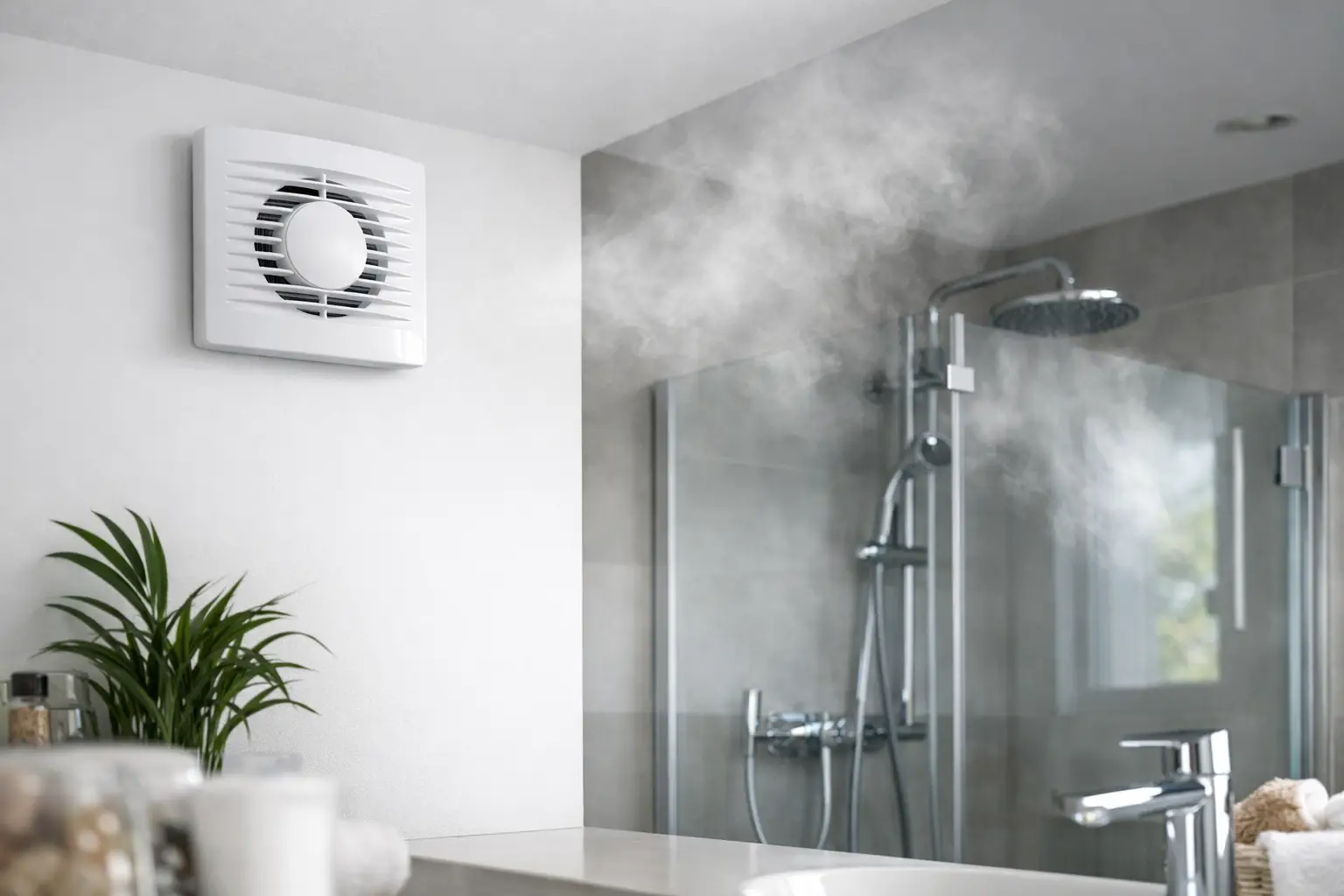
A bathroom fan that stops the moment the light is switched off often leaves the real moisture problem behind. Steam can remain in the room, on tiles and inside ceiling voids for 20 minutes or longer after a shower. A humidity controlled bathroom extractor fan responds to that lingering moisture automatically, helping to reduce condensation, mould growth and damage to paint, sealant and furnishings without relying on anyone to set a timer.
For most homes, it is not simply a question of buying the fan with the highest airflow figure. The right choice depends on the room volume, duct route, background ventilation, noise expectations and whether the fan must operate continuously or only when humidity rises. A correctly specified fan can run quietly and efficiently for years. An oversized or poorly installed unit can be noisy, underperforming and no more effective than a basic model.
Choosing the right humidity controlled bathroom extractor fan is one of the most effective ways to prevent condensation, mould growth and long-term moisture damage in modern bathrooms.
Browse our Humidity Sensor Bathroom Fans for automatic moisture-controlled ventilation
What a humidity controlled bathroom extractor fan does
A humidistat fan measures relative humidity (RH) in the air. When the moisture level exceeds its set point, the fan starts or increases its extraction rate. It then continues running until the humidity falls back to the selected level, usually with a built-in overrun period or sensor stabilisation.
This matters because showering is not the only source of moisture. Baths, drying towels, wet floors and ordinary occupancy all add water vapour. A fan controlled only by the light switch may run while the room is occupied but stop before the air has cleared. A humidity sensor provides control based on the condition that actually matters: moisture in the room.
Many domestic models allow a humidity threshold adjustment, commonly within a range around 60% to 90% RH. Settings vary by model, but 65% to 75% RH is often a practical starting point for a bathroom. A lower setting makes the fan more responsive, although it may cause unnecessary running in a naturally humid home or during wet weather. A higher setting can save electricity but risks allowing steam to remain for too long.
Choose airflow for the room and duct system
When choosing Bathroom Extractor Fans, the airflow rating alone does not tell the whole story. Most modern building standards recommend minimum extract ventilation rates for bathrooms, but these figures should be treated as a baseline rather than a guarantee of good real-world performance.
Even the best humidity controlled bathroom extractor fan cannot perform properly if the ductwork is undersized or poorly installed.
A fan’s quoted airflow is often measured under ideal conditions with little or no duct resistance. Once air travels through Flexible Air Ducts, bends, grilles and an external wall vent, the available airflow decreases. This is especially relevant in apartments and bathrooms where the fan discharges through a long ceiling void rather than directly through an external wall.
For a compact en-suite with a short 100 mm duct run, a standard axial bathroom fan can be adequate. For a family bathroom with a longer duct route, several bends or a roof terminal, Inline Duct Fans or centrifugal fans are often a better choice. These fan types generally develop higher static pressure, allowing them to maintain effective extraction against duct resistance.
Do not treat duct diameter as an afterthought. A 100 mm connection is common for smaller bathroom fans, while 125 mm and 150 mm systems can move more air with lower resistance. Reducing a larger fan outlet to fit an existing small duct may increase noise and restrict performance. Likewise, installing a powerful fan with old or crushed Flexible Air Ducts is unlikely to deliver the expected results.
Airflow and pressure are connected
Airflow, usually stated in m³/h or litres per second, tells you the volume of air a fan can move. Static pressure, measured in pascals (Pa), indicates how well it can push air through resistance. For a short, straight external-wall installation, airflow is often the key comparison. For ducted systems, pressure capability deserves equal attention.
A useful installation principle is to keep ducting short, straight and appropriately sized. Use rigid duct where practical, minimise sharp bends and make joints airtight. Flexible ducting is convenient, but its internal corrugations add resistance, particularly when it is stretched poorly or allowed to sag.
Noise level: look beyond the decibel figure
Bathroom extractor fan noise is often quoted in dB(A), but figures are only comparable when measured at the same distance and operating condition. A fan rated at 26 dB(A) may be very quiet in free air, yet become intrusive if vibration transfers into plasterboard, ductwork or a timber ceiling.
A premium humidity controlled bathroom extractor fan should combine low noise with sufficient airflow and pressure.
For bathrooms close to bedrooms, low noise is a genuine comfort requirement rather than a luxury. Fans in the low-to-mid 20 dB(A) range are generally perceived as quiet, while higher-flow models may operate around 30 dB(A) or more. The right balance depends on the duct system and the moisture load. A quieter fan that cannot overcome the duct resistance will not solve condensation.
Installation makes a major difference. Secure the fan correctly, avoid ducting that pulls on the casing, and use smooth bends rather than tight kinks. An inline fan positioned in a loft or ceiling void can reduce room noise because the motor is located away from the grille, but it must remain accessible for maintenance and installed in a suitable protected location.
Sensor controls and the functions worth paying for
Humidity sensing is the main feature, but control options affect how predictable the system feels in daily use. A fan with adjustable humidistat settings lets you tune the trigger point to the bathroom. This is useful where the room has a window, where showers are frequent, or where seasonal humidity varies significantly.
A timer overrun remains useful alongside humidity control. It can ensure a minimum extraction period after the light is switched off, even if the sensor does not register a sharp rise in RH. Some fans also include a pull cord, motion sensor, interval running or a trickle-speed mode. Continuous or decentralised mechanical extract ventilation models run at a low background rate and boost when humidity increases, supporting more consistent indoor air quality.
There is a trade-off. A basic humidistat axial fan is straightforward and economical, but may need adjustment if it responds to humid outdoor air entering through an open window. A continuous-running fan can provide steadier moisture control, although it requires more careful commissioning and may have different electrical and ventilation design requirements.
Look for a model with a reliable motor type, typically a ball-bearing motor for longer operating life and suitability for ceiling or wall mounting where specified. Low-power EC motors are particularly relevant for continuous operation because they can reduce electrical consumption while maintaining controlled airflow.
Electrical safety and bathroom zones
Bathrooms require proper attention to electrical safety. The fan’s IP rating, voltage and mounting location must suit the installation zone. A fan installed close to a shower or bath may require a higher ingress protection rating, often IPX4 or better depending on its position and the installation design.
Mains-powered fans should be installed in accordance with current UK electrical requirements by a competent person. Depending on the fan and wiring arrangement, the installation may need a permanent live supply, switched live and neutral. A humidity-controlled fan cannot operate after the light is switched off unless it has an appropriate permanent supply.
Check whether the model requires a three-core and earth cable, whether it is double insulated, and whether an isolator is needed for safe maintenance. These details are small on a product specification but decisive when replacing an existing fan. A fan with advanced controls may not work as intended if only a basic switched-live cable is available.
For broader guidance on healthy indoor environments and energy-efficient buildings, refer to the EU Energy Performance of Buildings Directive (EPBD).
Common reasons humidity fans appear not to work
A fan that runs continuously is not always faulty. The humidity setting may be too low, the bathroom may have high baseline humidity, or the sensor may be reacting to moist air from an adjacent room. Raise the threshold gradually and observe its behaviour over several shower cycles rather than making a large adjustment immediately.
If the fan starts but condensation persists, investigate airflow rather than assuming the humidistat is at fault. Blocked external grilles, backdraught shutters that stick, dirty impellers and restrictive ducting are common causes. So is a lack of replacement air. Extraction cannot work efficiently in a tightly sealed bathroom with no undercut beneath the door and no suitable air path into the room.
Cleaning is usually straightforward. Isolate the electrical supply, remove the front cover where the manufacturer permits it, and vacuum or wipe away dust from the grille and accessible impeller surfaces. Do not spray water or cleaning fluid into the motor or sensor. Check the external terminal periodically too, particularly after windy weather or insect activity.
Selecting the right fan for a renovation
Start with the duct route and required extraction performance, then choose controls and noise level. For a direct external-wall installation, a quiet 100 mm humidistat fan can be a sensible choice. For a ceiling-mounted bathroom with a long run to a roof terminal, prioritise pressure performance and consider an inline or centrifugal arrangement. For properties with persistent condensation or limited natural ventilation, continuous extract with humidity boost may justify the additional design and installation work.
At HavenPoint, the most useful comparison is rarely between headline airflow figures alone. Compare the stated airflow at pressure, sound level, duct connection, power consumption, IP rating, motor type, humidity adjustment range and mounting orientation. Confirm that the ducting, external grille, backdraught protection and electrical supply are compatible before ordering.
The best humidity controlled bathroom extractor fan is the one that removes moisture reliably without becoming a source of noise or nuisance. Set it sensibly, give it an unrestricted route outdoors and check it occasionally. Those practical details are what keep a bathroom dry long after the renovation is finished.
Recommended Humidity Controlled Bathroom Extractor Fans
Below are our recommended humidity controlled bathroom extractor fans for different bathroom sizes, installation types and budgets.
🌿 Best for smart humidity control
Soler & Palau ECOAIR EVO HT Bathroom Fan with Timer & Humidistat
Advanced humidity-controlled extractor fan with EC motor, ultra-quiet operation and automatic moisture control.
⭐ Best overall for most bathrooms
Soler & Palau SILENT DUAL 100 Bathroom Fan with Humidity Sensor
Continuous low-speed ventilation with automatic humidity boost for reliable everyday moisture control.
🔇 Best for ultra-quiet operation
Soler & Palau SILENT-100 CHZ Design Bathroom Fan
Ultra-quiet bathroom extractor fan with timer, ideal for standard bathrooms and short duct installations.
Frequently Asked Questions
What humidity should a bathroom be?
Around 50–60% RH during normal use. After showering, humidity naturally rises but should return to normal within a reasonable period.
Should I leave a humidity controlled bathroom extractor fan running?
Yes. The fan should continue running automatically until humidity falls below the selected threshold.
What humidity setting is best?
Most manufacturers recommend starting around 65–75% RH and adjusting if necessary.
Can a humidity sensor replace a timer?
In many cases yes, although many premium fans combine both functions.