
Knowledge hub
Choosing a Condensate Drain Tray for Air Conditioner
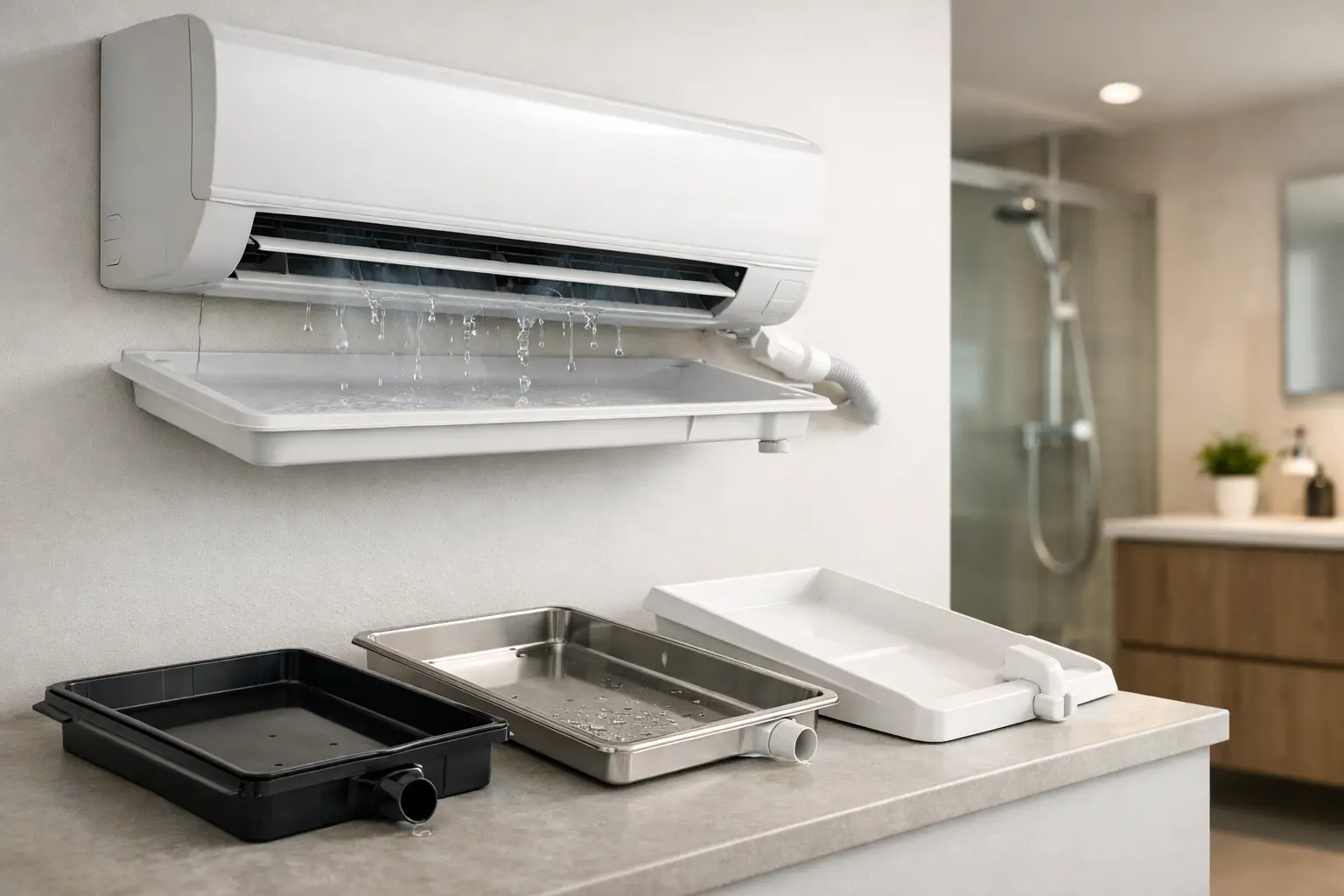
A wet patch beneath an air-conditioning unit is rarely just a cosmetic problem. Water can stain façades, saturate paving, freeze around an outdoor unit or find its way into a wall or ceiling void. The right condensate drain tray for air conditioner installations collects this water at source and directs it to a suitable drain point, rather than leaving its path to chance.
For many split systems, the indoor unit produces condensate while cooling and removes it through its built-in drain pan and pipework. Outdoor units can also discharge significant water, particularly reversible air conditioners and heat pumps during defrost operation in heating mode. A correctly selected external tray is therefore part of the drainage design, not simply an accessory fitted after a leak appears.
What a condensate drain tray does
A condensate drain tray, also called a drip tray or drainage tray, sits below an air-conditioning outdoor unit or beneath equipment where water discharge needs to be controlled. It catches water leaving the unit base and channels it towards one or more drain outlets. Depending on the installation, that outlet may connect to a gravity drain, a condensate pump, a suitably designed soakaway or an approved drainage route.
The tray has a different job from the factory-fitted pan inside an indoor evaporator. The internal pan collects moisture condensed from room air and sends it into the condensate pipe. An external tray manages water discharged below the outdoor unit, most commonly defrost water from an air-to-air heat pump operating in winter.
This distinction matters when diagnosing a leak. If water is escaping from the front or underside of an indoor wall unit during cooling, a blocked internal condensate line, incorrect pipe fall or dirty pan is more likely than a missing outdoor tray. If water is pooling under the outdoor unit in cold weather, the tray, drain outlet and frost protection should be assessed together.
Choosing a condensate drain tray for air conditioner installations
Tray selection begins with the exact unit, not the nominal cooling capacity alone. Outdoor units with similar outputs can have different footprints, base-frame arrangements and drain-hole positions. Check the manufacturer’s drawing for the unit width, depth, support locations and underside drainage arrangement before ordering.
The tray must be large enough to capture discharge from the relevant openings without obstructing the unit supports or airflow. A tray that is too narrow may allow water to bypass its edges. One that is unnecessarily deep or poorly positioned can make access for servicing harder and may interfere with wall brackets, mounting feet or anti-vibration supports.
Material choice affects longevity. Galvanised or coated steel trays offer mechanical strength and are commonly used with external mounting systems, but the finish should be suitable for the installation environment. In exposed coastal, industrial or persistently damp locations, corrosion resistance deserves particular attention. UV-stable plastic trays can be practical where their temperature limits, loading and fixing method suit the application. Always use the manufacturer’s stated temperature range and load guidance rather than assuming that any tray can tolerate freezing conditions or equipment weight.
A useful specification check covers four connected details:
- the outdoor unit footprint and support arrangement;
- tray dimensions, edge height and number of drain outlets;
- outlet size and compatibility with the intended condensate pipe or fitting;
- material, corrosion protection and permitted operating temperature.
It is also worth confirming whether the tray is designed to carry the unit directly or to sit beneath separate mounting brackets or feet. Many drainage trays are collection components, not structural bases. Supporting a condenser on a tray that was not designed for the load can distort it, compromise drainage and make vibration worse.
Drain outlet position and pipe fall
A tray only works if its outlet can drain freely. Locate the outlet where the connecting pipe can run with continuous fall and without sharp bends, crushed sections or low points that retain water. Condensate pipework should be adequately supported so that it cannot sag after installation.
Where gravity fall is impossible, a condensate pump may be appropriate, but it adds a component that requires accessible installation and maintenance. The pump must be selected for the anticipated flow, lift and pipe run. It should not be used to compensate for a poorly planned route where a gravity drain is readily achievable.
Avoid routing discharge across walkways, entrances or areas where winter ice could create a hazard. Local drainage rules and the building’s drainage arrangement determine where condensate may be discharged. A refrigeration engineer or qualified installer should confirm the compliant route, especially where a connection to building drainage is proposed.
Defrost water changes the design calculation
An outdoor unit running in cooling mode may produce little or no water beneath the casing. In heating mode, however, an air-source heat pump periodically defrosts its outdoor coil. The resulting meltwater can be substantial for a short period, particularly during cold, damp weather.
This is why a tray installation that appears satisfactory in summer can fail in winter. The concern is not only collection volume. Water can freeze in the tray outlet, in the drain pipe or at the discharge point. Once blocked by ice, water may overflow, refreeze around the unit and affect the immediate area.
For installations exposed to frost, assess the full drainage path rather than specifying the tray in isolation. Depending on the system design and manufacturer guidance, this may involve an appropriately rated trace-heating arrangement, insulated pipework where appropriate, a short external run, or a route that avoids vulnerable shallow sections. Heating elements must be compatible with the tray and pipe materials, installed safely and protected by suitable electrical controls.
Do not seal every opening in an outdoor unit base in an attempt to force water into a tray. Base drainage is part of the unit’s designed operation. Follow the air-conditioner manufacturer’s instructions for drain plugs, outlet fittings and cold-weather use.
Installation details that prevent nuisance leaks
The outdoor unit should remain level and securely mounted on compatible brackets, a ground frame or other approved supports. Level mounting helps water reach the intended discharge points and supports correct compressor operation. The tray should be fixed according to its installation instructions, with sufficient clearance for pipe connections and future cleaning.
Consider the complete assembly: wall bracket, anti-vibration mounts, tray, drain connection, pipe clips and termination point. Mixing parts without checking dimensions can leave a drain outlet blocked by a bracket rail or create a pipe route with no fall. This is particularly common where a tray is added after the outdoor unit has already been fitted.
Keep service access in mind. Engineers need room to inspect electrical connections, refrigerant pipework, valves and the unit underside. A tray should make water management more controlled, not turn routine maintenance into a dismantling job.
If the unit is installed above a balcony, doorway, public route or sensitive façade finish, drainage control becomes more important. In these locations, a tray can prevent staining and dripping below, but the final discharge point still needs careful planning. Capturing water only to release it at the edge of the same balcony does not solve the underlying issue.
Maintenance is simple but necessary
A condensate tray needs periodic inspection, especially before the heating season and after leaf fall. Remove leaves, moss, insect debris and construction dust that can block outlets. Check that the drain pipe remains firmly connected, that clips have not loosened and that water can flow through the termination point.
Look for corrosion, cracked plastic, damaged coatings and standing water after the unit has stopped running. Persistent standing water may indicate insufficient fall, a blocked outlet or a distorted tray. During freezing weather, inspect for ice build-up rather than trying to chip at the outdoor coil or force open a frozen drain connection.
For indoor condensate faults, maintenance should also include the internal drain pan, pipe and any pump reservoir. Cleanliness matters because biological growth and debris can restrict narrow condensate routes over time.
When a tray is the right answer
A drain tray is particularly useful where an outdoor air-conditioning or heat-pump unit discharges above finished surfaces, balconies, access routes or building elements that should remain dry. It is also a sensible part of a planned installation where controlled drainage is needed from the outset.
It is not a cure for every water problem. A leaking indoor unit, an incorrectly sized condensate pump, a blocked siphon or pipework without adequate fall requires diagnosis at the relevant component. Selecting the tray around the unit footprint, drainage route and local winter conditions will provide a controlled result that remains practical to inspect and maintain.