
Knowledge hub
Anti Vibration Mounts for an Air Conditioning Unit
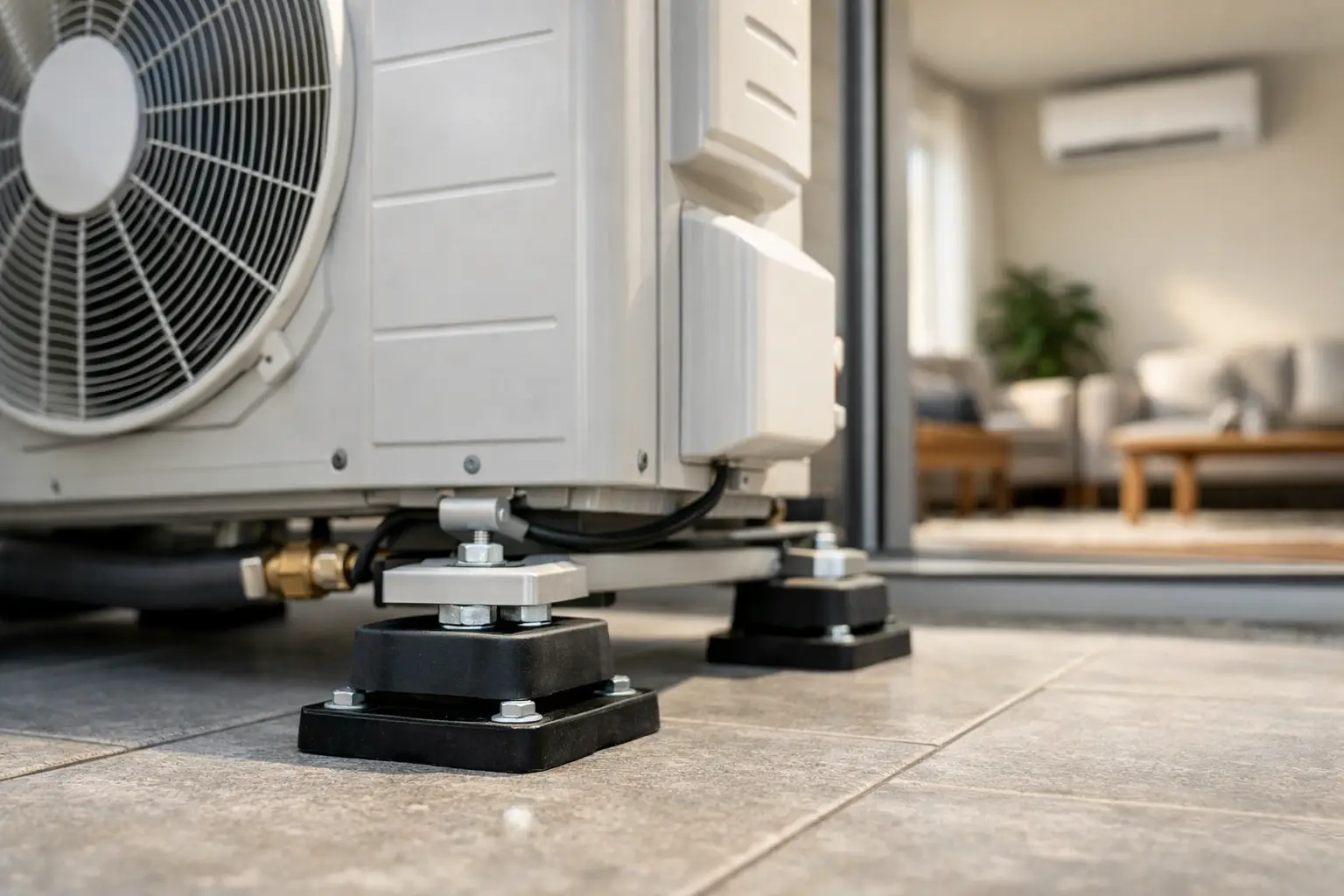
A quiet air-conditioning system can become surprisingly intrusive when the outdoor unit transfers compressor vibration into a wall bracket, concrete slab, balcony or timber deck. Anti vibration mounts for an air conditioning unit are a small installation component, but the correct type and load rating can make a meaningful difference to structure-borne noise, pipework stress and long-term stability.
They are not a cure for every noisy condenser. A worn fan motor, damaged compressor, loose casing panel or poorly secured refrigerant line needs attention first. Where the unit itself is operating normally, however, properly selected mounts isolate vibration before it reaches the building structure.
Why air-conditioning outdoor units vibrate
An outdoor condensing unit contains a compressor, fan motor and fan blade assembly. During cooling or heating operation, these parts generate vibration at different frequencies. The compressor is usually the main source of low-frequency vibration, while fan imbalance, loose fixings and airflow turbulence can introduce additional noise.
The unit’s metal base frame transmits that movement into its support. If it sits directly on concrete, steel brackets or a rigid roof frame, the support can act as a bridge. Vibration then travels through walls, floors and ceilings, sometimes appearing indoors as a hum rather than obvious external noise.
This is why sound pressure level alone does not tell the full story. A condenser may meet its stated acoustic rating at a measured distance, yet still disturb occupants if its vibration is coupled directly to the building. Isolation mounts reduce this transmission path. They do not necessarily make the compressor quieter at source, but they can stop the structure from amplifying it.
Choosing anti vibration mounts for an air conditioning unit
The right mount must support the equipment securely while allowing enough controlled deflection to isolate vibration. Selecting a soft rubber block simply because it feels flexible is not a reliable method. If a mount is overloaded, it can compress excessively, lose its isolation characteristics or allow the unit to become unstable. If it is too stiff for the load, it behaves much like a solid spacer.
Start with the outdoor unit’s operating weight, not only its shipping weight. Then divide this across the mounting points, allowing for unequal weight distribution caused by the compressor position. Four mounts are common, but the load will not always be identical at each corner. The manufacturer’s mounting layout and the support bracket design should determine the final arrangement.
Load rating and deflection
Each anti-vibration mount has a specified load range or maximum load. Choose a model that works within its intended operating range at the load applied to each support point. This is more useful than selecting by diameter or height alone.
Deflection matters because it indicates how the resilient element responds under weight. A mount with controlled compression can reduce the transfer of vibration, whereas a fully compressed rubber element cannot isolate effectively. The product data should be checked for permissible load, dimensions, fixing thread or bolt diameter, and the temperature range suitable for its location.
Outdoor equipment can be exposed to heat from discharge air, frost, rainwater and ultraviolet light. Materials designed for HVAC installation are preferable to improvised pads, particularly where the unit is installed on a roof, balcony or exposed wall bracket.
Rubber feet, rails and spring mounts
Rubber anti-vibration feet are commonly used beneath floor-mounted outdoor units and on condenser support frames. They are compact, straightforward to install and suitable for many residential split systems where the unit has a stable, level base.
Anti-vibration rails provide a longer support surface beneath the unit. They can simplify positioning, spread the load across the base frame and keep the condenser slightly above the supporting surface. This can be useful on flat roofs or paved areas where drainage and access underneath the unit matter.
Spring mounts are generally chosen for heavier equipment or applications where lower-frequency isolation is required. They need correct selection and installation, as excessive movement is undesirable for refrigerant connections and outdoor pipework. For a typical domestic air-conditioning condenser, rubber mounts or dedicated support rails are often appropriate, but the unit weight and installation location decide the specification.
Match the mounts to the support method
A ground-mounted condenser on a concrete pad has different requirements from one fixed to a masonry wall. On the ground, the priority is a flat, stable, drained base that prevents the unit from settling or standing in water. Anti-vibration feet should sit evenly, and the unit must remain level within the manufacturer’s permitted tolerance.
Wall-mounted units require particular care. The bracket itself must be sized for the unit’s weight and securely fixed to suitable structural material. Mounts installed between the outdoor unit and bracket can reduce vibration transfer, but they cannot compensate for undersized brackets, poor anchors or a lightweight wall that resonates. On timber-frame construction, a free-standing ground support may sometimes offer better acoustic results than mounting directly to the façade, subject to site conditions and manufacturer guidance.
Roof installations introduce further considerations. The support must protect the roof covering, distribute load correctly and allow rainwater to drain freely. A rail system with suitable pads can be practical, but the roof’s structural capacity and wind-loading requirements must be assessed. Do not place an outdoor unit on loose paving slabs, insulation boards or makeshift timber packing.
Installation details that affect noise
Even correctly rated mounts will underperform if other components create a rigid path back to the building. Refrigerant pipework is a common example. Copper lines should be clipped securely but not pulled tight against brickwork, metalwork or the condenser casing. Where specified, use suitable pipe clips, liners and protection to prevent rubbing and vibration transmission.
The condensate drain also needs attention. A drain hose that vibrates against cladding or a gutter can create a persistent rattle. Maintain the required fall, prevent kinks, and secure the route without crushing the hose. In cold conditions, drainage arrangements must also account for freezing risk around the outdoor unit.
Electrical cable, trunking and service covers should be fixed firmly. Loose conduit, poorly fitted decorative channel and unsecured bracket crossbars can all create noise that is incorrectly blamed on the compressor. After installation, inspect the system through a full operating cycle, including fan speed changes and defrost operation on an air-to-air heat pump.
Use the mount’s intended fixing method. Some designs require bolts, washers and locking nuts; others are configured as rails with pre-formed channels. Tighten fixings sufficiently to secure the unit, but do not compress a resilient mount beyond the manufacturer’s instructions. Over-tightening can bypass the isolating element and turn the mount into a rigid connection.
What anti-vibration mounts cannot fix
If a previously quiet unit suddenly becomes noisy, mounting feet should not be the first assumption. Check for a fan blade contacting the guard, ice accumulation, loose screws, damaged rubber feet, debris in the casing or vibration from refrigerant pipes. A pronounced mechanical knock, grinding sound or major change in compressor noise should be assessed by a qualified refrigeration engineer.
Likewise, poor airflow can increase operating stress and noise. Keep the condenser’s air intake and discharge clear, respect the manufacturer’s minimum clearances, and avoid enclosing the unit in a decorative box that restricts airflow. Restricted airflow may raise condensing pressure, reduce efficiency and make the fan work harder.
Mounts also cannot correct an oversized or badly located air-conditioning system. A condenser installed immediately beneath a bedroom window, in a narrow reverberant courtyard or on a flexible balcony surface may remain noticeable even with effective isolation. Location, airflow clearance, service access and acoustic impact should be considered before the installation is fixed in place.
A practical selection checklist
Before purchasing, confirm the outdoor unit’s operating weight, base-frame fixing dimensions and number of support points. Check whether the unit will sit on the ground, a slab, a wall bracket or a roof support, then select mounts compatible with that arrangement. Review the mount’s load rating, dimensions, fixing size, material and environmental suitability.
Also plan the complete installation: brackets or support rails, weather-resistant fixings, condensate drainage, refrigerant pipe clips, cable routing and required service clearances. HavenPoint’s HVAC installation range is designed for this wider system approach, because a stable condenser depends on more than the rubber directly beneath it.
The best result is usually quiet rather than silent: a correctly installed outdoor unit will still produce normal operating sound, but it should not make the wall, floor or bracket part of the noise. Treat anti-vibration mounts as a precise support component, and the installation will be easier to live with and easier to maintain.