
Knowledge hub
Why Does an Air Source Heat Pump Lose Efficiency in Cold Weather?
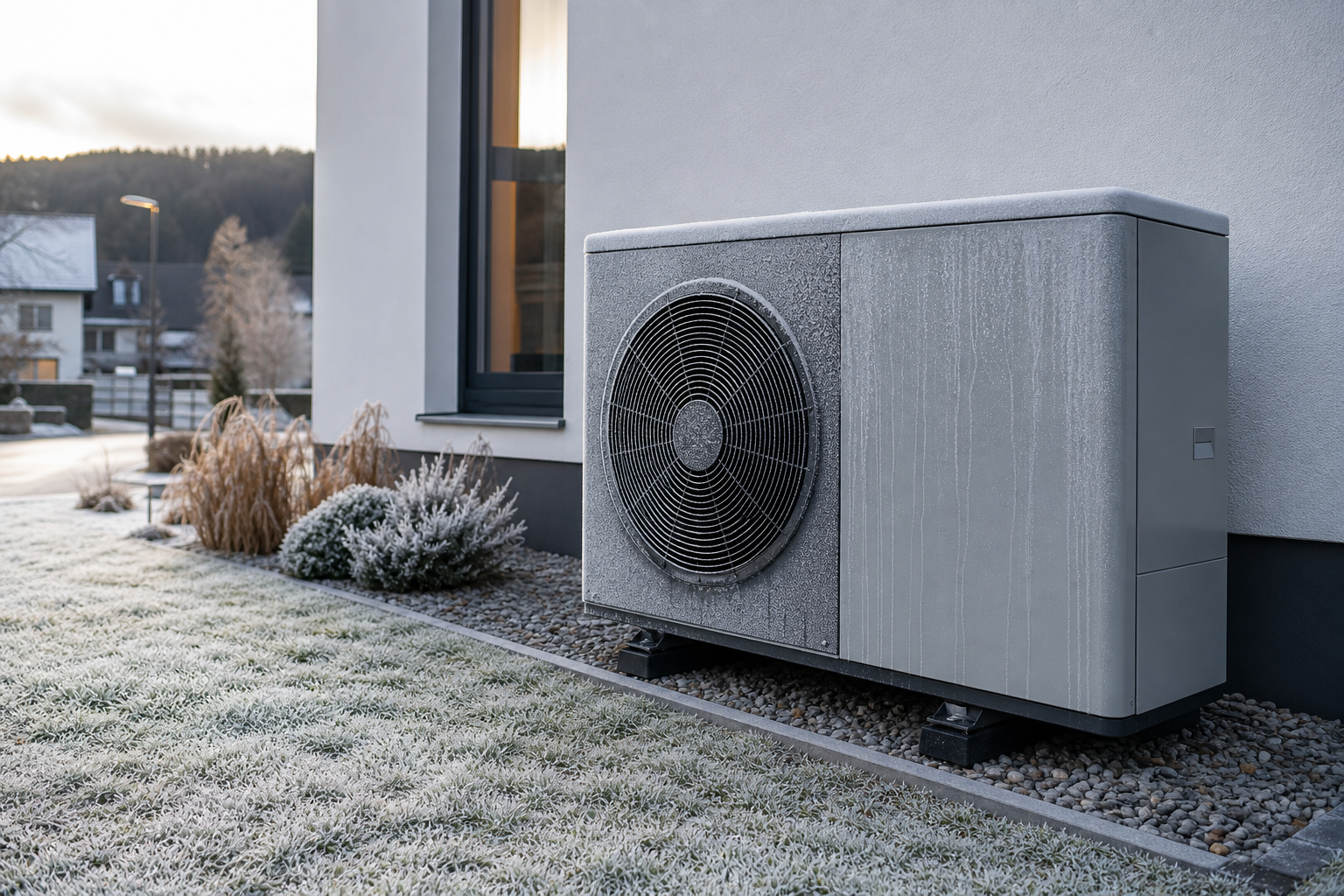
Air source heat pump efficiency in cold weather normally falls because the refrigerant circuit must create a larger temperature lift as outdoor air gets colder. At the same time, the unit’s available heating capacity may fall while the building’s heat demand rises. The practical question is therefore not whether a product is labelled “8 kW”, but how much heat that exact unit can deliver at the local design outdoor temperature and at the leaving-water temperature the heating system actually requires.
Quick Answer
Cold weather changes several quantities at once. Heating capacity is the useful heat the unit can deliver; electrical input is the power it consumes; COP is useful heat divided by electrical input at one operating point; and seasonal efficiency averages performance across a wider range of conditions. These values are related, but they are not interchangeable.
A heat pump can remain suitable for a cold climate even though its COP and capacity decline. Suitability depends on whether its capacity curve still meets the building’s rising heat-load curve at the required water temperature, how defrost affects operation, and what controlled auxiliary heat is available below the balance or bivalent point.
Table of Contents
- Why colder outdoor air changes performance
- Heating capacity, power input and COP
- Why leaving-water temperature matters
- Two manufacturer capacity-table examples
- Building heat demand and the balance point
- Defrost and auxiliary heat
- How to read a capacity table before buying
- Practical checks, FAQ and next step
How an Air Source Heat Pump Works in Cold Conditions
An air source heat pump does not create heat from electricity in the way a resistance heater does. It moves heat from the outdoor air into the home using a refrigeration cycle. The outdoor coil absorbs heat, the compressor raises the refrigerant pressure and temperature, and the indoor heat exchanger releases that heat into the heating system.
When outdoor air is colder, there is still usable heat in it, but less of it. The heat pump can still operate, yet it has to work against a less favourable temperature difference. That is why heat pump performance in winter depends so strongly on outdoor climate, required supply temperature, and emitter design.
| Cold-weather factor | What happens | Effect on efficiency |
|---|---|---|
| Lower outdoor air temperature | Less heat is available to extract | COP falls |
| Higher required flow temperature | Compressor must lift heat further | More electricity used |
| Frost on outdoor coil | Unit must defrost periodically | Temporary heat loss and extra energy use |
| Poor airflow or blocked coil | Heat transfer gets worse | Performance drops further |
Why Colder Outdoor Air Changes Heat-Pump Performance
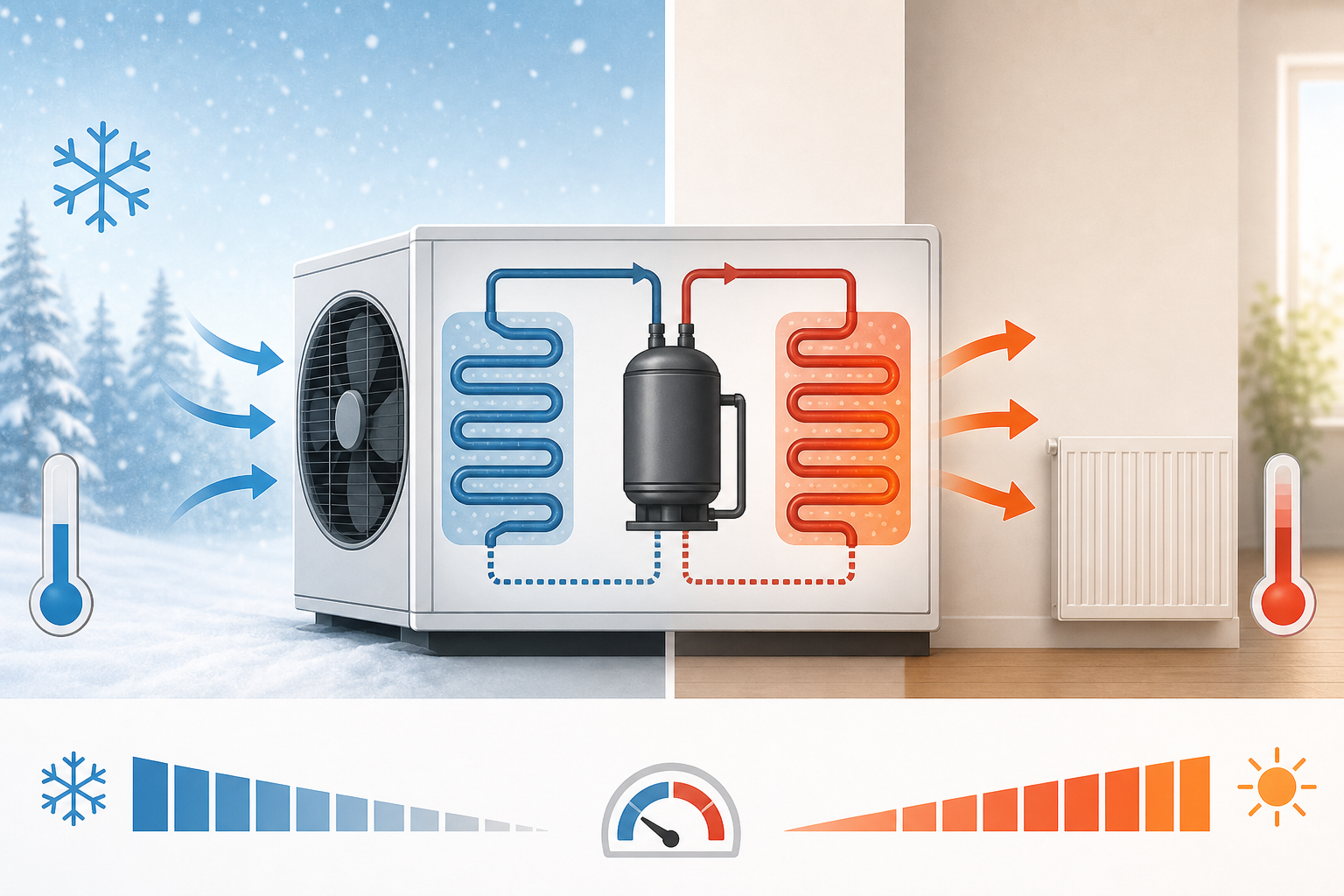
The refrigerant evaporating temperature must be below the outdoor air temperature so that heat can enter the outdoor coil. As the air gets colder, the compressor must raise the refrigerant from a lower source temperature to the temperature needed by the indoor water circuit. That larger temperature lift generally increases compressor work and reduces COP.
Cold-weather performance is not only an efficiency question. A unit may draw more electrical power while delivering less maximum heat than it can in mild weather. Electricity consumption can still rise even if COP remains above 1 because the building needs more heat, the compressor runs longer, and auxiliary heat may operate.
Heating Capacity, Electrical Input and COP Are Not the Same
Heating capacity (HC) is useful heat output in kilowatts. Power input (PI) is electrical demand in kilowatts at the same stated operating point. COP is the ratio HC ÷ PI. A COP of 2.0 means 2 kW of heat is delivered per 1 kW of electrical input at that particular test point; it does not describe the whole season.
Seasonal efficiency accounts for changing temperatures, part-load operation and other seasonal effects under a defined method. It is useful for broad comparison, but neither a single COP nor a seasonal label replaces the model-specific capacity check required for design.
Why Leaving-Water Temperature Matters
The heat pump has to deliver the water temperature required by the emitters. Low-temperature floor heating may provide comfort with much cooler water than a radiator system designed around a high boiler temperature. Requiring hotter water increases the refrigerant temperature lift and normally reduces both available efficiency and, depending on the unit, useful capacity.
This is why an outdoor temperature alone is not a complete test condition. Capacity-table notation such as A-7/W35 or a row and column defined by the manufacturer combines an outdoor-air condition with a leaving-water condition. The definitions in the specific document must be followed exactly.
What Manufacturer Capacity Tables Actually Show
The nominal model class is not a promise of constant output. The following are two manufacturer examples at approximately 35°C leaving-water temperature. They illustrate the engineering principle, but they are not a direct performance comparison because the outdoor-temperature definitions and table conventions are not identical.
Daikin ERGA08DV: Integrated, 100% Load
The supplied Daikin ERGA08DV table defines Ta as ambient wet-bulb temperature. It describes HC as heating capacity at maximum operating frequency measured according to EN 14511. The table reports HC and PI; the final column below is calculated as HC ÷ PI and is not a COP value printed directly in the source.
| Daikin Ta, wet-bulb | HC at 35°C LWT | PI | Calculated HC ÷ PI |
|---|---|---|---|
| +7°C | 9.37 kW | 2.08 kW | 4.50 |
| -7°C | 7.28 kW | 2.73 kW | 2.67 |
| -15°C | 6.58 kW | 3.16 kW | 2.08 |
| -20°C | 6.14 kW | 3.43 kW | 1.79 |
NØRDIS OPTIMUS PRO Split HOP8WODU: Maximum Operation
The supplied NØRDIS engineering table defines outdoor temperature as dry-bulb temperature and reports HC, PI and COP directly for Maximum, Normal and Minimum operation. The values below use Maximum operation and the 35°C leaving-water column.
| NØRDIS outdoor DB | HC at 35°C LWT | PI | Reported COP |
|---|---|---|---|
| +7°C | 9.11 kW | 1.80 kW | 5.07 |
| -7°C | 7.27 kW | 2.26 kW | 3.21 |
| -15°C | 6.11 kW | 2.51 kW | 2.43 |
| -20°C | 4.74 kW | 2.24 kW | 2.11 |
| -25°C | 3.59 kW | 2.19 kW | 1.64 |
Two Manufacturer Examples — Not a Direct Performance Comparison
The Daikin rows use ambient wet-bulb temperature, while the NØRDIS rows use outdoor dry-bulb temperature. The documents also present their operating data differently. The numbers therefore must not be used to rank the manufacturers or claim that one brand is better in cold weather. Their shared lesson is narrower: output and efficiency depend on the exact model, outdoor condition, operating level and leaving-water temperature.
What Is Normal vs What May Indicate a Problem
Some winter decline is normal. A heat pump can still work in freezing weather, but capacity and efficiency usually fall as outdoor conditions become colder. That alone does not mean there is a fault.
| Observation | More likely normal | May indicate a problem |
|---|---|---|
| Lower efficiency in cold weather | Yes, expected | Only if the drop is extreme or inconsistent with conditions |
| Short defrost periods | Yes, expected in cold damp weather | Yes, if very frequent or long |
| Higher electricity use when it is colder outside | Yes | Yes, if the system cannot maintain comfort without excess backup heat |
| Room temperatures falling despite continuous operation | Sometimes during extreme weather | Often points to undersizing, emitter mismatch, or control issues |
Signs that deserve a closer check include frequent backup heater use, persistent frosting, poor airflow around the outdoor unit, unusually noisy operation, or a home that never reaches target temperature unless the flow temperature is raised a lot.
How Defrost Cycles Affect Efficiency
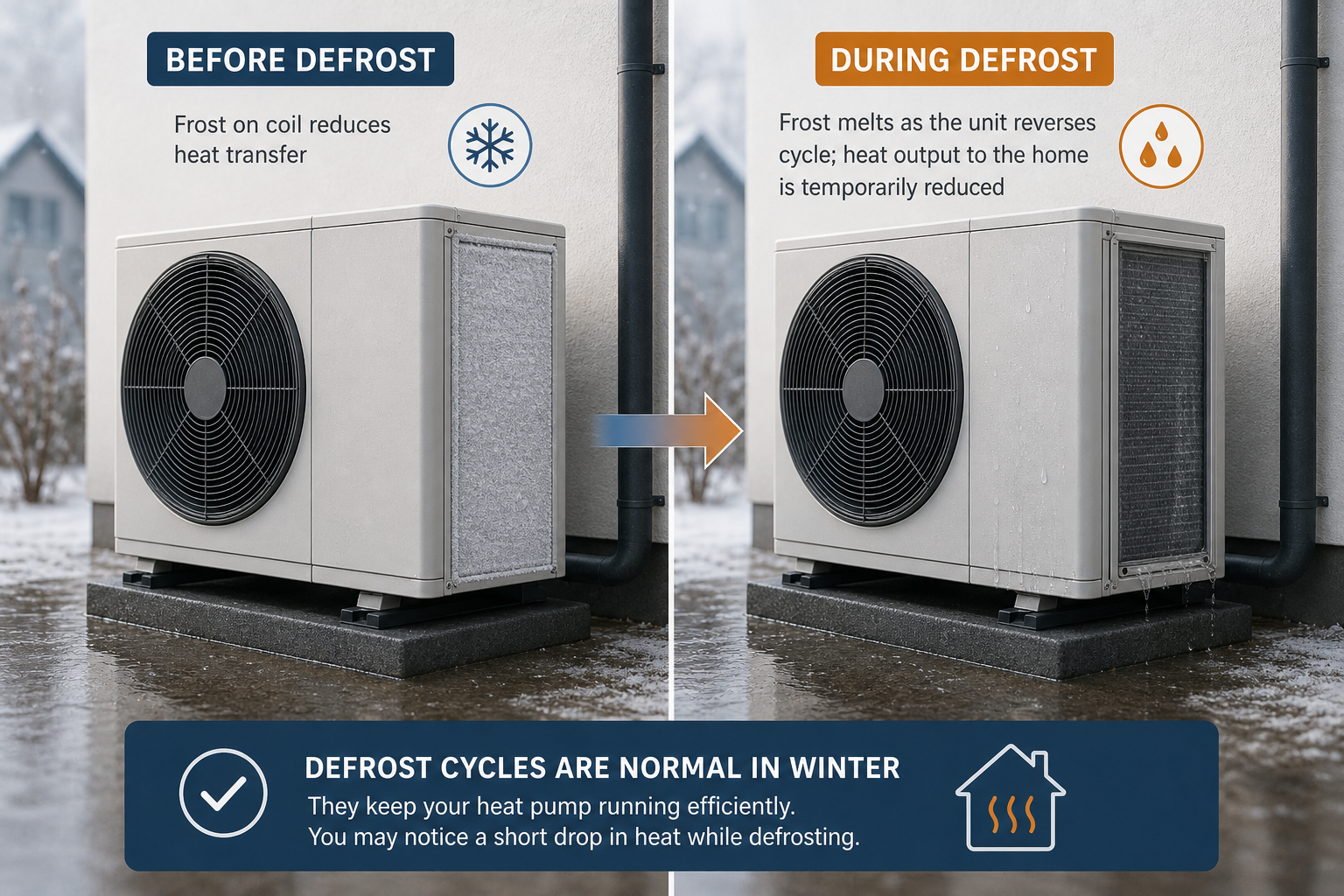
When outdoor humidity is high and the coil is cold, frost can form on the outdoor unit. A defrost cycle reverses operation briefly to remove that frost. During that time, heat output to the house falls and energy use rises, so seasonal efficiency drops.
This is normal behaviour for air-source systems in cold weather. The impact varies with weather pattern, coil design, control strategy and outdoor-unit placement. Some manufacturers highlight smarter defrost management because reducing unnecessary or long defrost cycles helps protect winter performance.
If defrosting seems too frequent, check whether the outdoor coil has clear airflow, whether leaves or snow are obstructing the unit, and whether the system is working in a humid frosty microclimate. If the behaviour is persistent, it may need professional diagnosis.
Building Heat Demand vs Heat-Pump Capacity
As outdoor temperature falls, the building usually loses heat faster, so its required heating capacity rises. At the same time, the heat pump’s available capacity may decline. The point where the building-load curve meets the heat-pump capacity curve is often called the balance point or, in bivalent systems, the bivalent point.
Below that point, the heat pump may still operate efficiently and contribute substantial heat, but it may no longer meet the entire building load by itself. The design then determines whether an electric element, boiler or another controlled heat source supplies the shortfall. There is no universal correct balance temperature: it depends on the building, climate, emitter temperatures, tariff assumptions and the selected unit.
How to Read a Heat-Pump Capacity Table Before Buying
- Obtain a defensible design heat-load calculation for the building.
- Identify the relevant local design outdoor temperature.
- Determine the leaving-water temperature the emitters need at that condition.
- Find the exact model’s heating capacity at or near the same outdoor and water-temperature condition.
- Check power input and COP at that same point where the manufacturer provides them.
- Read the manufacturer’s definitions: dry-bulb versus wet-bulb, maximum versus nominal or integrated operation, and any standard or footnote.
- Allow for defrost, installation conditions and control behaviour without inventing a universal penalty.
- Decide what supplies any shortfall below the balance point and how auxiliary heat is controlled.
An “8 kW heat pump” may not provide 8 kW at -7°C, -15°C or -20°C, especially if the heating system also requires hot water to the emitters. The useful purchasing question is: how much heating capacity can this exact unit deliver at my design outdoor temperature and required leaving-water temperature?
When Auxiliary Heat Becomes Relevant
Auxiliary heat is relevant when heat-pump capacity is below the building load, during certain operating or recovery conditions, or where the system strategy intentionally uses a second heat source. Its presence does not automatically prove poor heat-pump design. What matters is whether the expected operating point, control sequence, electricity demand and annual contribution were considered during selection.
How to Reduce Efficiency Loss in Cold Weather
- Keep flow temperature as low as the house can comfortably tolerate.
- Use properly sized emitters, especially if the home relies on radiators.
- Improve insulation and reduce heat loss where practical.
- Make sure the outdoor unit has clear airflow and is not blocked by debris or snow.
- Check that controls, sensors and defrost behaviour are set up correctly.
- Review whether the system was sized for the actual heat loss of the building.
- Maintain the unit so coils and heat exchangers stay clean and airflow remains good.
If you are trying to improve heat pump efficiency, the first question should usually be whether the home can heat acceptably at a lower flow temperature. That single change often matters more than small changes to the heat pump itself.
Practical Real-World Example
Two homes can have the same heat pump and very different winter results. A well-insulated house with large radiators may run comfortably at lower water temperature, so the heat pump keeps a better COP even when the weather turns cold. Another home with higher heat loss and undersized emitters may need much hotter water, which reduces efficiency and can make the unit appear to “struggle” even though the root cause is system design.
That is why winter troubleshooting should start with the building and the heating circuit, not only the outdoor unit.
Common Mistake Homeowners Make
The most common mistake is comparing real winter performance with brochure COP numbers and assuming any shortfall means the heat pump is defective. Those lab values are measured under defined test conditions. Your home may need a different flow temperature, face different weather, and lose more heat than the test setup assumes.
Another mistake is blaming the outdoor unit before checking radiator size, insulation, airflow clearance and control settings.
HavenPoint Expert Tip
If a heat pump looks inefficient in winter, ask one simple question: can the house stay warm at a lower flow temperature? If the answer is no, the first fix is often not a new heat pump but better emitter sizing, better heat-loss reduction, or a control adjustment that lets the system run more efficiently.
What a Good Diagnostic Check Should Cover
- Outdoor temperature and recent weather pattern
- How often defrost occurs
- Set flow temperature and whether it is higher than necessary
- Radiator or underfloor heating suitability
- Indoor comfort at normal operating settings
- Outdoor-unit clearance and coil condition
- Whether backup heat is being used more than expected
If you need a deeper diagnosis, compare the system’s behaviour across a few cold days rather than judging it from one frosty morning. Performance changes with humidity, wind and load, so a single snapshot can be misleading.
FAQ
Do air source heat pumps still work in freezing weather?
Yes. They can still operate in freezing conditions, but efficiency and capacity usually fall as outdoor temperature drops. The exact low-temperature capability depends on the model.
Why heat pumps lose efficiency when it gets colder?
Because the compressor must move heat from colder air to a warmer heating system. The greater the temperature difference, the more work the compressor must do for each unit of heat delivered.
What is a defrost cycle heat pump event?
It is a short operating mode used to remove frost from the outdoor coil. It is normal in cold damp weather, but it temporarily reduces delivered heat and increases energy use.
How can I improve heat pump efficiency in winter?
Lower the flow temperature where possible, improve insulation, use suitable emitters, keep the outdoor unit clear, and make sure the system is correctly sized and maintained.
Are EPREL efficiency figures the same as home performance?
No. They are useful comparison figures, but installed performance depends on the home, climate, emitters and control setup.
Conclusion
Air source heat pump efficiency in cold weather falls for normal thermodynamic reasons, and some decline is expected. The biggest practical influences are flow temperature, emitter size, insulation, sizing, defrost behaviour and installation quality. If winter performance seems poor, start by checking the heating system and the building, not only the heat pump itself.
If you are comparing heat pump options for a colder climate or want to understand whether your current system is performing normally, contact HavenPoint for practical guidance based on your home and heating setup.