
Knowledge hub
How to Improve Airflow in a Stuffy Bedroom

A stuffy bedroom usually means the room is not getting enough fresh air, air is not mixing properly, or moisture and heat are building up overnight. The fastest safe fixes are to clear the air path into and out of the room, use brief purge ventilation when outdoor conditions allow, and add mechanical ventilation if passive measures are not enough.
This guide explains how to improve airflow in a stuffy bedroom without guessing. It focuses on practical steps for European homes, and it also explains when a fan, a door gap, or a mechanical ventilation system is the better long-term answer.
Quick answer: the fastest fixes for a stuffy bedroom
If your bedroom feels stale, start with the simplest checks: open a window briefly for purge ventilation, make sure the door is not sealing the room too tightly, and use a fan only to mix air, not as a substitute for fresh air. If the room still feels stuffy with the window closed, the real issue is usually poor ventilation, poor air transfer, excess humidity, or a closed-off room layout.
- Open the window for a short, effective air change when outdoor air quality, noise, and security allow.
- Keep a clear path for air to enter and leave the room.
- Leave a door undercut or transfer path unobstructed if the home depends on internal air movement.
- Use a quiet fan to improve mixing, especially in corners and dead zones.
- Check for condensation, humidity, and overheating, not just stale smell.
If those steps do not solve the problem, passive airing may not be enough and the bedroom may need continuous mechanical ventilation or a whole-home ventilation strategy.
Table of contents
- Why a bedroom feels stuffy
- Simple steps to improve airflow naturally
- When windows are not enough
- Fan use, door gaps, and room layout
- Common mistakes that make airflow worse
- Practical example of an improvement plan
- FAQ
Why a bedroom feels stuffy
A stuffy bedroom is not always a temperature problem. In many homes, the main cause is insufficient fresh-air supply, combined with poor air mixing and moisture released overnight by breathing and normal room use. If the room is tight, the door is closed, and the window stays shut, stale air can build up quickly.
There are four common patterns that can feel similar but need different fixes.
| Likely cause | What you notice | What usually helps |
|---|---|---|
| Poor ventilation | Stale smell, condensation, heavy air | Fresh-air supply, extract, whole-home ventilation |
| Poor air mixing | Air feels dead in one part of the room | Fan use and clearer air paths |
| Excess humidity | Window condensation, damp feel, possible mould risk | Reduce moisture and improve background ventilation |
| Overheating | Room feels hot and airless, especially at night | Ventilation plus heat control |
Improving insulation or airtightness can reduce heat loss, but it can also reduce air exchange. That is why a renovated bedroom may feel more stuffy than an older leaky room unless ventilation is preserved or added.
Simple steps to improve airflow naturally
Natural ventilation works best when you create a clear route for air to enter, move through, and leave the room. The aim is not just to open a window, but to help air actually move through the space.
1. Use short purge ventilation
When outdoor conditions are suitable, open the bedroom window wide for a short period rather than leaving it slightly open for a long time. A brief purge can replace stale indoor air more effectively than a tiny opening, especially if the room has been closed overnight.
This is usually the fastest low-cost fix, but it is not always practical. Outdoor noise, pollution, security, weather, and heat loss can limit how often you can use it.
2. Clear the air path through the room
Air needs a route. If the bedroom door seals too tightly, fresh air may enter but not leave properly, which limits circulation. A door undercut, transfer grille, or another planned air path can help the room exchange air with the rest of the dwelling.
This matters most in homes that rely on whole-dwelling airflow. If air can enter the bedroom but cannot move onward to extract points or other rooms, the bedroom may stay stale even with a window cracked open.
3. Reduce indoor moisture sources
Ventilation can dilute moisture, but it cannot remove the source of the moisture. Drying clothes, bringing damp items into the room, or ignoring condensation can keep the bedroom feeling heavy even if airflow improves.
If you see morning condensation on the window, treat that as a warning sign. It suggests overnight moisture is building up and may need background ventilation or humidity control, not just more fan movement.
4. Re-check room layout
Large furniture placed close to vents, windows, or door openings can block circulation. Dense curtains, closed storage in front of air paths, and a bed pushed into a stagnant corner can all worsen the feeling of stale air.
Sometimes the fix is as simple as moving one item of furniture to open a flow path.
When windows are not enough: mechanical ventilation options
If the bedroom stays stuffy with normal airing, passive ventilation may not be enough for the dwelling. This is more likely in airtight renovated homes, noise-sensitive locations, or rooms that cannot be left open safely overnight.
Mechanical ventilation can provide a steadier supply of fresh air and more reliable moisture removal. The right choice depends on whether the problem is local to one room or part of the whole home.
| Option | Best for | Trade-off |
|---|---|---|
| Continuous extract ventilation | Bedrooms tied into a broader airflow strategy | Needs correct room balancing and installation |
| Heat-recovery ventilation | Airtight homes needing continuous fresh air | Higher system complexity and commissioning needs |
| Local wall or window extract | Rooms with a clear single-room problem | Can be limited by noise, facade rules, or appearance |
| Fan only | Mixing air and comfort support | Does not supply fresh air on its own |
Heat-recovery ventilation can be especially useful where opening windows would cause too much heat loss. It supplies fresh air while recovering some heat from exhaust air, although the actual result depends on system design and installation quality.
For many homes, the key question is not whether to add equipment, but whether the bedroom needs a room-level fix or a whole-home ventilation solution. Mechanical systems should be sized and commissioned for the dwelling, not chosen only because the room feels uncomfortable.
Fan use, door gaps, and room layout considerations
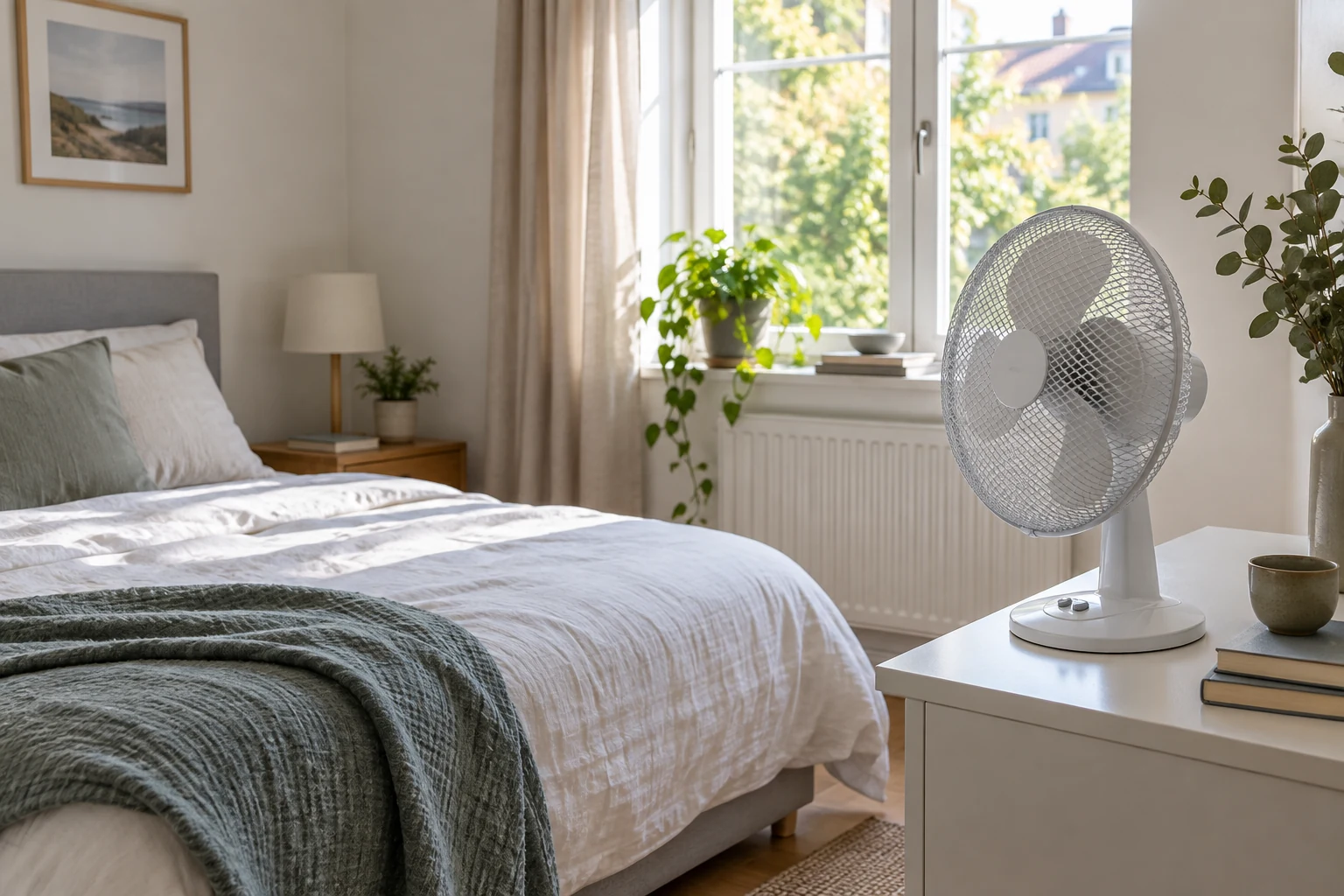
Here, “fan” means a portable room-air circulation fan, such as a desk or pedestal fan. It can make a bedroom feel fresher by mixing indoor air and improving perceived comfort, but it does not bring fresh outdoor air into the room or correct a genuine ventilation shortfall by itself.
Think of the fan as a mixer, not a supplier. It helps distribute air more evenly, which can improve comfort and reduce stagnant pockets near the bed or in corners.
- Use a fan to break up stagnant zones, especially in larger bedrooms.
- Do not point the airflow only at one spot if the goal is whole-room mixing.
- Keep internal door paths open so air can move through the dwelling.
- Avoid blocking supply or extract points with wardrobes, curtains, or bedding.
- Use the fan together with ventilation, not instead of it.
If the bedroom is part of a whole-home system, the room may need air to enter through one path and leave through another. A tightly sealed door can interrupt that flow and make the room feel stale even when other rooms are ventilated properly.
Common mistakes that make airflow worse
Many airflow problems are made worse by well-meant changes. The room may look better, but the air path becomes weaker.
- Sealing the bedroom too tightly after renovation.
- Using a fan as the only fix for stale air.
- Ignoring humidity and condensation.
- Blocking door gaps or transfer paths with rugs or thresholds.
- Expecting window opening alone to solve a chronic ventilation issue.
- Installing ventilation without checking local rules, noise, or building constraints.
The most common mistake is treating every stuffy bedroom as a circulation problem. In reality, the room may need fresh-air supply, moisture control, or a whole-house ventilation review.
HavenPoint Expert Tip
Start with the cheapest diagnostic step first: open the window briefly, leave the door path unobstructed, and check whether the room feels better within a few minutes. If it improves quickly, the issue is probably mainly airflow. If it improves only slightly, moisture, heat, or airtightness may be part of the problem too.
Practical example: a bedroom airflow improvement plan
Here is a realistic sequence for a typical bedroom that feels stale in winter.
- Open the window widely for a short purge when conditions are suitable.
- Keep the bedroom door gap clear so air can move through the room.
- Move furniture away from the main air path and away from any vent.
- Use a small fan to mix air around the room.
- Check the window each morning for condensation.
- If the room still feels stuffy most nights, assess whether the home needs continuous mechanical ventilation.
In an airtight renovated apartment, that same plan may not be enough. In that case, the better long-term answer may be a mechanical ventilation solution that provides steady background airflow, especially if the bedroom has no reliable cross-ventilation route.
FAQ
Why does my bedroom feel stuffy even when it is not hot?
Stale air is often caused by poor fresh-air exchange, not just temperature. Humidity, low air movement, and a closed room layout can all make the bedroom feel heavy.
Does a fan improve bedroom air quality?
A fan can improve bedroom air circulation and comfort, but it does not bring in fresh air. It helps mix the air that is already in the room.
What is the best quick fix for stale air in a bedroom?
Short purge ventilation is usually the fastest practical fix when outdoor conditions allow. It works best if the room also has a clear path for air transfer.
When should I consider mechanical ventilation?
Consider mechanical ventilation if the room stays stuffy after simple passive measures, especially in airtight homes, high-noise areas, or rooms with recurring condensation.
Can I solve a stuffy bedroom just by opening the window at night?
Sometimes, but not always. Night-time window opening can help, yet it may also increase heat loss, noise, security risk, and outdoor pollutant exposure.
Do local rules matter for bedroom ventilation upgrades?
Yes. Retrofit options can be affected by national rules, building type, noise limits, fire constraints, and local planning or heritage requirements. Check the applicable rules before modifying the room or facade.
Conclusion
To improve airflow in a stuffy bedroom, start by creating a real air path, using short purge ventilation when appropriate, and checking whether humidity or room layout is part of the problem. A fan can help the room feel less stagnant, but it is not a substitute for fresh air.
If passive steps do not work, the bedroom likely needs a mechanical solution matched to the home, not just a stronger fan. For a sensible next step, check your bedroom’s ventilation setup and explore the most suitable HavenPoint solutions for improving comfort and indoor air quality.
Check your bedroom’s ventilation setup and explore the most suitable HavenPoint solutions for improving comfort and indoor air quality. Explore heat recovery units
References
- World Health Organization — WHO Housing and health guidelines
- BUILD UP / European Commission context — Guidance for the EPBD recast: Opportunities for ventilative cooling
- European Commission Joint Research Centre — JRC report on ventilation and indoor air quality in Europe (PDF)
- Vent-Axia — HR100RS Heat Recovery Bottom Access
- Vent-Axia — Lo-Carbon Revive SELV 7 (Switchee Enabled)
- European Commission — Ventilation Units – European Commission
- European Commission — Ecodesign and energy labelling – Ventilation
- ISO — ISO/FDIS 16890-1 – Air filters for general ventilation