


Choosing Airtight Sealant for Ventilation Ducts

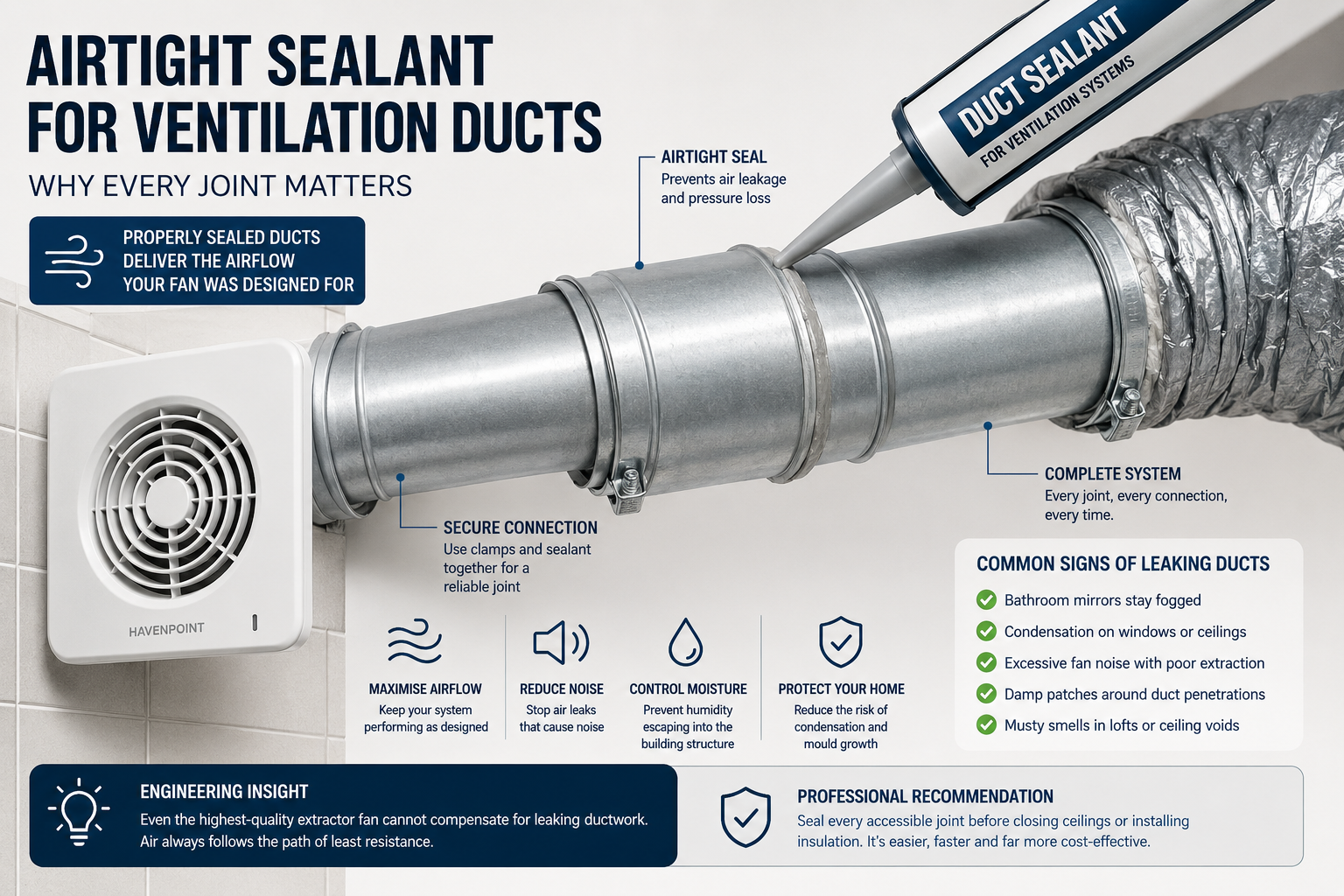
Airtight Sealant for Ventilation Ducts: Why Every Joint Matters
A bathroom extractor fan can have the correct airflow rating and still leave steam hanging in the room if the ductwork leaks at every joint.
Even small air leaks reduce fan pressure, waste energy and allow warm, humid air to escape into ceiling voids or loft spaces instead of being exhausted outdoors. Over time, this can lead to condensation, mould growth and poor ventilation performance.
An airtight sealant for ventilation ducts is one of the simplest and most cost-effective ways to improve a ventilation system. Properly sealed joints help maintain airflow, reduce pressure losses, minimise noise and protect the building from moisture damage.
Whether you’re installing a new bathroom extractor fan, upgrading an existing system or fitting an inline duct fan, airtight duct joints are essential for achieving the airflow the fan was designed to deliver.
Quick Answer
An airtight sealant for ventilation ducts prevents air leakage at duct joints, helping maintain airflow, reduce pressure losses and improve extraction performance. Correctly sealed ductwork also reduces noise, limits moisture escaping into the building structure and improves long-term ventilation efficiency.
Why Duct Airtightness Matters
Every ventilation system works by creating a pressure difference that moves air from the room to the outside.
The fan must overcome resistance from:
- Ductwork
- Bends and fittings
- External terminals
- Backdraft dampers
- Filters
- Silencers
Every leaking joint changes that designed airflow path.
Instead of extracting humid air from the bathroom, the fan may draw replacement air through gaps in ceiling voids or loft spaces. At the same time, warm, moisture-laden air can leak into the building structure before it reaches the external terminal.
The result is reduced airflow, higher humidity and poorer ventilation performance.
💡 HavenPoint Engineering Insight
Even the highest-quality extractor fan cannot compensate for leaking ductwork. Air always follows the path of least resistance, meaning every unsealed joint reduces the fan’s ability to remove moisture where it matters most. In many installations, sealing the duct system correctly delivers a greater improvement than replacing the fan with a more powerful model.
Common Signs of Leaking Ductwork
Poorly sealed ductwork often goes unnoticed until moisture problems begin to appear.
Look for these common warning signs:
- Bathroom mirrors stay fogged for a long time
- Condensation forms on windows and ceilings
- The fan sounds loud but extracts poorly
- Damp patches appear around duct penetrations
- Musty smells develop in lofts or ceiling voids
- Whistling or hissing noises come from duct joints
Professional airflow measurements are the most reliable way to identify leakage, but many problems can also be found during a careful visual inspection.
⚠️ Common Installation Mistake
Applying sealant to a poorly fitting duct joint will not fix the installation. Duct sections should fit securely before sealing, with the sealant providing airtightness rather than mechanical strength.
Choosing the Right Airtight Sealant
Not every sealant is suitable for ventilation systems. The correct product depends on the duct material, operating temperature and installation environment.
Comparison
| Material | Best Use | Important Limitation |
|---|---|---|
| Duct Sealant / Mastic | Metal and rigid plastic duct joints | Requires curing before full operation |
| Foil Tape | Vapour barrier and insulation sealing | Not suitable for loose or poorly fitted joints |
| Expanding Foam | Around wall or ceiling penetrations | Never use as the primary duct joint seal |
Not all products are interchangeable. Always check the manufacturer’s compatibility with the duct material before installation.
Choosing the Right Airtight Sealant
Selecting the correct sealant depends on the duct material, operating temperature and installation environment. Not every sealant, tape or adhesive is suitable for ventilation systems.
A common mistake is assuming that all products labelled as “sealants” perform the same function. In reality, different materials are designed for different applications.
Comparison
| Material | Best Use | Important Limitation |
|---|---|---|
| Duct Sealant / Mastic | Metal and rigid plastic duct joints | Requires curing before full operation |
| Foil Tape | Vapour barriers and duct insulation | Should not be used to compensate for loose joints |
| Expanding Foam | Around wall and ceiling penetrations | Never use to seal duct joints inside the airflow path |
Always follow the duct and sealant manufacturer’s recommendations to ensure long-term compatibility.
Rigid Metal Ductwork
For galvanised steel and other rigid metal duct systems, purpose-made duct sealants or duct mastics provide the most reliable airtight seal.
A quality duct sealant should:
- Remain flexible after curing
- Resist vibration and thermal movement
- Maintain airtightness for many years
- Be suitable for the expected operating temperature
A brittle seal can crack over time, allowing air leakage to return even if the installation initially performs well.
Plastic Ventilation Ducts
Plastic ducting requires additional attention because not every sealant is compatible with every polymer.
Some solvent-based products may:
- Soften plastic ductwork
- Cause stress cracking
- Damage rubber seals
- Affect insulated duct components
Always check the manufacturer’s compatibility information before applying any sealant to plastic ventilation ducts.
📐 Engineering Note
Ventilation duct joints are exposed to vibration, thermal expansion and contraction throughout their service life. A sealant that remains flexible after curing is generally more reliable than one that becomes rigid and brittle.
Foil Tape: Useful but Often Misused
Foil tape is widely used within ventilation systems, but it should only be applied where it is designed to perform.
It is particularly suitable for:
- Vapour barrier repairs
- Duct insulation joints
- Specific duct systems recommended by the manufacturer
However, foil tape should never be used to disguise a poorly fitted duct connection.
Dust, moisture, textured surfaces and excessive tension all reduce the service life of adhesive tapes. Where rigid duct joints remain accessible, a mechanically secure connection combined with an appropriate duct sealant is usually the more dependable solution.
⚠️ Common Installation Mistake
Wrapping several layers of foil tape around a loose duct joint rarely creates a permanent airtight seal. Correctly fitting the duct components before sealing is always the first step.
Temperature, Condensation and Movement
Different ventilation systems operate under very different conditions.
Bathroom extract ducts carry warm, humid air.
Kitchen extract systems may experience higher temperatures and airborne grease.
Air conditioning ductwork can operate below room temperature, creating condensation risks.
When selecting a sealant, consider:
- Maximum operating temperature
- Exposure to moisture
- Thermal expansion
- Long-term flexibility
- Compatibility with the duct material
An airtight joint prevents humid air from escaping through the connection, but it does not prevent condensation forming on an uninsulated cold duct.
Proper insulation remains essential wherever condensation is likely.
✔ Professional Recommendation
Professional HVAC installers seal every accessible duct joint before insulation, ceiling boards or boxing-in are completed. Repairing hidden air leaks after installation is considerably more time-consuming and expensive.
How to Create a Reliable Airtight Duct Joint
A long-lasting airtight joint begins long before the sealant is applied.
Clean, properly aligned duct sections create a reliable mechanical connection, while the sealant provides the airtight barrier that prevents air leakage.
Follow these steps for the best results:
- Cut the duct squarely and remove any sharp edges or burrs.
- Clean the joint surfaces so they are free from dust, grease and moisture.
- Dry-fit the components to ensure they align correctly.
- Apply a continuous bead of sealant around the mating surface.
- Fully insert the duct into the coupling or spigot.
- Secure the connection using the appropriate clamp or mechanical fixing.
- Allow the sealant to cure according to the manufacturer’s instructions.
- Inspect every accessible joint before closing ceilings or installing insulation.
Avoid applying excessive sealant inside the duct, as cured material can disturb airflow and collect dust over time.
Where Every Joint Should Be Sealed
Some of the most important duct joints are hidden once the installation is complete.
Before ceilings, boxing or insulation are installed, check every accessible connection.
Pay particular attention to:
- Duct-to-spigot connections
- Couplers
- Reducers
- Elbows and bends
- Branch connections
- Connections to Inline Duct Fans
- Connections to External Wall Grilles
- Connections to Roof Vent Terminals
- Longitudinal seams on metal ductwork where applicable
For Flexible Ducting, ensure the duct fully covers the spigot and is secured using an appropriate clamp before applying compatible sealant where recommended by the manufacturer.
✔ Professional Recommendation
Professional HVAC installers inspect every duct joint before commissioning the ventilation system. Finding and repairing hidden leaks after ceilings have been closed is significantly more expensive than sealing the joints correctly during installation.
Airtight Sealant Is Only Part of the Solution
A perfectly sealed ventilation system can still perform poorly if the duct design itself creates excessive resistance.
Good ventilation depends on the complete system working together.
For the best results:
- Match the duct diameter to the fan’s airflow requirements.
- Keep duct runs as short and straight as practical.
- Minimise unnecessary bends.
- Use Rigid Plastic Ducting wherever possible.
- Support ducts correctly to prevent movement.
- Install suitable Backdraft Dampers and External Wall Grilles.
- Use quality Duct Clamps to maintain secure connections.
Airtight joints help the fan achieve its designed airflow, but they cannot compensate for undersized ducts, excessive bends or poorly planned installations.
💡 HavenPoint Engineering Insight
A ventilation system should always be considered as a complete airflow path rather than a collection of individual components. High-quality fans, oversized ducts and premium accessories cannot deliver their full performance if air escapes through poorly sealed joints.
Recommended Products
For reliable and long-lasting duct installations, consider combining quality sealants with properly matched ventilation components.
Recommended product categories:
Frequently Asked Questions
What is the best sealant for ventilation ducts?
Purpose-made duct sealants or duct mastics are generally the most reliable choice for rigid metal and compatible plastic ventilation systems.
Can I use silicone sealant on ventilation ducts?
Only if the manufacturer confirms it is suitable for the duct material and operating conditions. Many general-purpose silicone sealants are not designed specifically for HVAC applications.
Is foil tape enough to seal duct joints?
Foil tape can be suitable for certain insulation and vapour barrier applications, but it should not replace a properly fitted mechanical joint sealed with an appropriate duct sealant.
Should flexible ducting be sealed?
Yes. Flexible duct connections should fit securely over the spigot, be clamped where required and sealed only with products approved by the duct manufacturer.
Can leaking ductwork cause condensation?
Yes. Air leaks allow warm, moisture-laden air to escape into lofts, ceiling voids or wall cavities, increasing the risk of condensation and mould growth.
Does sealing duct joints reduce fan noise?
Often, yes. Airtight joints reduce whistling, vibration and unwanted air leakage that can contribute to higher operating noise.
Can expanding foam be used on ventilation ducts?
Expanding foam is suitable around building penetrations but should not be used as the primary seal between duct components.
How long should duct sealant cure before using the system?
Always follow the manufacturer’s curing instructions. Cure time depends on the sealant type, bead thickness, temperature and humidity.
Final Thoughts
Small air leaks can have a surprisingly large impact on ventilation performance.
Choosing the correct sealant, preparing every joint carefully and inspecting the complete duct system before commissioning helps maintain airflow, reduce noise and protect the building from long-term moisture problems.
Whether you’re installing a simple bathroom extractor fan or a complete whole-house ventilation system, airtight duct joints are one of the easiest improvements you can make for better performance and greater reliability.
External Reference
For further guidance on ventilation system design and ductwork best practices, see the recommendations published by ASHRAE and CIBSE, two of the world’s leading authorities on HVAC engineering.