Choosing an Inline Duct Fan for Long Duct Runs

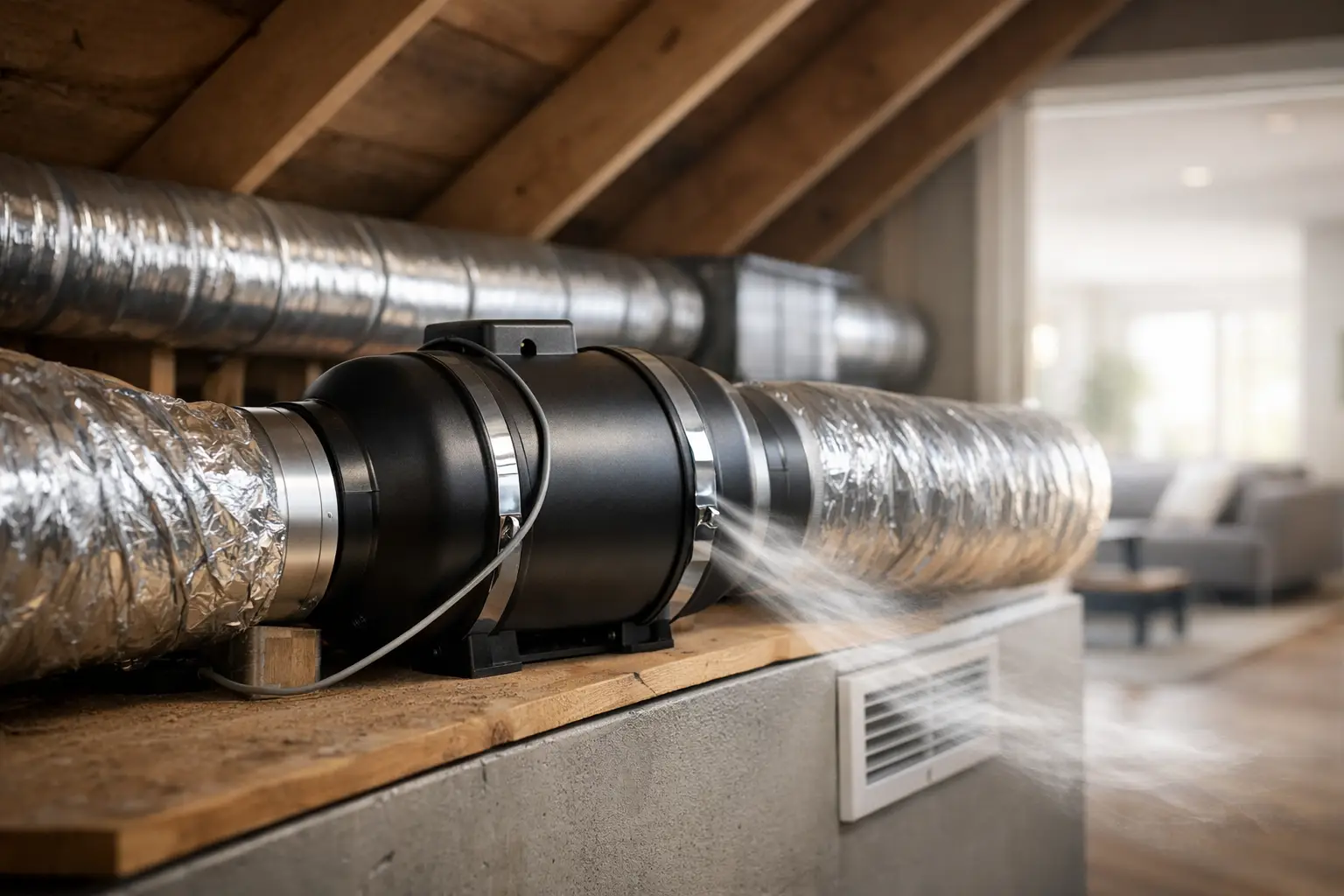
A fan that performs well on a short straight duct can become disappointingly weak once it is connected to 8, 12 or 20 metres of ducting. The issue is rarely the fan alone. Selecting an inline duct fan for long duct runs means accounting for the resistance created by every metre of duct, bend, grille, backdraught shutter and roof or wall terminal.
For a bathroom, utility room, kitchen extract system or remote ventilation point, the correct fan is the one that delivers the required airflow at the system’s actual operating pressure. The free-air airflow figure on a product page is useful, but it is not the figure that determines performance in a real installation.
Why long duct runs need a different fan choice
Air loses energy as it moves through a duct. Straight ducting creates friction, while elbows, flexible duct, reducers and external grilles add local resistance. This resistance is measured as static pressure, usually in pascals (Pa). As system pressure rises, the available airflow from a fan falls.
A short run with a wide, smooth duct may allow a standard axial fan to extract adequately. Add several bends, a narrow duct and an external louvre, however, and the same fan may move far less air than expected. The consequence is familiar: steam remains after showering, mirrors take longer to clear, odours linger, and moisture can accumulate in colder parts of the building.
Inline mixed-flow and centrifugal fans are generally more suitable than basic axial fans where resistance is significant. Their design allows them to maintain useful airflow at higher static pressures. That does not mean every long run requires the highest-pressure fan available. An oversized fan can increase noise, electrical consumption and draught, particularly if it is paired with undersized ducting.
Start with airflow, then check static pressure
First establish the extraction duty for the room and application, taking account of the relevant building requirements, room use and occupancy. A small cloakroom, a family bathroom and a frequently used utility room do not impose the same moisture load. Kitchen extraction also needs careful planning because grease, heat and the type of cooker hood affect the system design.
Next, assess the duct route rather than relying on its end-to-end length. Record the duct diameter, total straight length, number and type of bends, any reducers, flexible sections, silencers, grilles, dampers and terminal. A 90-degree elbow can add considerably more resistance than a gentle-radius bend, and compressed flexible duct performs much worse than a fully extended length.
Use the manufacturer’s fan curve to match airflow and static pressure. The curve shows how much air the fan can deliver as resistance increases. Find the estimated system pressure on one axis, then read across to see the airflow available at that point. This is the most reliable way to compare inline fan models for a demanding duct route.
If a full pressure calculation is not practical, treat a long route with multiple bends, narrow ducting or restrictive terminals as a higher-resistance application. Select a fan with published pressure performance rather than choosing solely by its maximum airflow in free air.
Duct diameter matters more than many installations allow for
Increasing duct diameter often reduces resistance more effectively than fitting a more powerful fan. Air velocity drops in a larger duct for the same airflow, which reduces friction and can also lower air noise. For this reason, a fan with 125 mm or 150 mm connections may be the more sensible choice for a long run, even where the room itself is relatively small.
Avoid reducing the duct immediately after the fan simply to use an existing grille or wall sleeve. A reduction creates a bottleneck and raises velocity. It can make the system noisier and remove much of the benefit of a pressure-capable inline fan. Where a transition is unavoidable, keep the reduced section as short as possible and use a smooth, correctly sized adaptor.
Rigid smooth-wall ducting is normally preferable for long sections. Flexible duct is useful for short connections and awkward final alignment, but it should be pulled taut, supported properly and kept free from sharp kinks. Sagging flexible duct creates pockets that restrict airflow and may collect condensation.
Choosing an inline duct fan for long duct runs
A practical selection process considers the complete specification, not one headline number. Check the nominal duct connection size and confirm that it matches the planned ductwork. Then compare airflow at the anticipated static pressure, not just maximum m³/h. Also review sound data, motor type, power consumption, ingress protection where relevant, operating temperature limits and the installation orientation permitted by the manufacturer.
EC motors can be particularly useful where variable speed control, lower part-load consumption or continuous background ventilation is required. They may be controlled by a compatible speed controller, sensor or building control arrangement, but compatibility must be verified. Not every speed controller is suitable for every AC or EC motor, and incorrect control can cause humming, unstable operation or premature motor failure.
For intermittent bathroom extraction, a fan may be paired with a timer, humidity controller or external switch. Humidity control is valuable where occupants do not reliably leave the fan running after bathing, but the sensor should be located where it can respond to room humidity rather than direct steam or cold external air. In a long duct system, allow sufficient run-on time for the fan to clear humid air from both the room and the duct.
A backdraught shutter can prevent cold air entering while the fan is off, but it adds resistance. Choose a low-resistance damper where possible and do not assume that a shutter is cost-free in airflow terms. The same applies to fine insect mesh and decorative grilles. These components may be necessary, but they must be included in the system assessment.
Installation details that protect real-world performance
An inline fan is often quieter in the room than a wall-mounted fan because the motor can be installed in a loft, ceiling void or service area. It is not automatically silent. Fan noise can travel through ductwork, and vibration can transfer into timber, plasterboard or metal framing.
Mount the fan securely using suitable brackets or suspension hardware, without crushing the casing or duct connections. Use flexible connectors or short acoustic connections where the fan manufacturer permits them, particularly near occupied rooms. A correctly sized duct silencer can reduce transmitted fan noise, though it will add some resistance and needs to be considered in the pressure calculation.
Position the fan where it remains accessible for inspection and cleaning. A fan buried beneath insulation or behind a fixed ceiling without an access route becomes difficult to maintain. In cold roof spaces, insulate ductwork carrying warm, moist extract air to reduce condensation risk. The duct should be supported and arranged so any condensate cannot run back towards the fan or room.
Air removed from a room must be replaced. A bathroom door undercut, transfer grille or planned air path allows replacement air to enter. Without it, the fan operates against increasing negative pressure and airflow falls. This is one reason a powerful fan does not always cure poor extraction.
Common causes of disappointing extraction
If a newly fitted inline fan seems underpowered, check the duct route before replacing it. The most frequent faults are crushed flexible duct, an unnecessary reduction, too many tight bends, a blocked external grille, a closed damper, or a duct terminal exposed to strong wind. A terminal selected for weather protection can still be unsuitable if its free area is too limited for the required airflow.
Also check that the fan direction matches the airflow arrow on its casing. This sounds basic, but it is an easy error where the fan is installed remotely. Confirm that any speed controller is set correctly and that a humidity sensor is not switching the fan off too early.
For existing systems, cleaning can make a material difference. Dust on the impeller, deposits on grilles and debris in a backdraught shutter all increase resistance. Isolate the electrical supply before servicing, then follow the manufacturer’s cleaning instructions. Do not spray water or cleaning fluid into a motor housing unless the product documentation specifically permits it.
Buy the fan as part of the system
The best result comes from specifying the fan, duct diameter, bends, terminal, controls and mounting method together. A high-pressure inline fan can solve a difficult route, but only if the ductwork gives it a sensible path to move air through.
Before ordering, sketch the route and compare it against the fan curve and connection dimensions. That small amount of planning can prevent a noisy installation that still leaves the bathroom damp – and it gives the fan a realistic chance to deliver the airflow it was chosen for.